
What's inside
- Best Portable Lithium Battery Pack for Camping: Chemistry, Capacity, and Charging
- Best Portable Lithium Battery Pack for Camping: Quick Comparison
- The Six Camping Battery Packs Reviewed
- Buying Guide: How to Choose the Best Portable Lithium Battery Pack for Your Camping
- Frequently Asked Questions About Portable Lithium Battery Packs for Camping
As an Amazon Associate I earn from qualifying purchases. This post may contain affiliate links at no extra cost to you.
The best portable lithium battery pack for camping is the one whose capacity matches your actual loads, because this category punishes both directions of error with equal enthusiasm. Buy too small and the phones die on the second night, the camera battery waits for a charge that never finishes, and the CPAP question, if it is your question, becomes a safety calculation instead of a comfort. Buy too large and you have carried a twenty pound brick to charge two phones, spending expedition money on a tent side errand. Between those errors sits the honest middle this guide maps: the pocket power banks that carry a phone through a long weekend, and the small portable power stations, three hundred to eight hundred watt-hours, that run lights, cameras, drones, laptops, and camp comforts for days. Six real, currently sold lithium packs and stations are compared below, graded for camping specifically, weight against watt-hours, charging speed against solar manners, and chemistry against the cold nights and hot cars of a camping life, with the arithmetic taught plainly enough that you can size any model this guide did not list.
Learn the one equation before the table, because every buying decision in this category is that equation wearing a costume. Capacity is measured in watt-hours, and a load’s appetite is measured in watts, and the hours you get are the watt-hours divided by the watts, less a tax of roughly fifteen percent for conversion losses that no maker escapes. A phone’s battery holds roughly fifteen watt-hours, so a one hundred watt-hour pack charges it about five or six times after the tax; a string of camp lights drawing ten watts runs thirty hours on a three hundred watt-hour station; a heated blanket drawing sixty watts empties that same station in about four hours, which is why this guide will tell you, in its place, that electricity is a terrible way to make heat and insulation is the camper’s power station. Write your loads down, phone, headlamp, camera, drone, laptop, medical devices first and always, multiply by nights, add the tax and a margin, and the correct size class chooses itself. The campers who skip the arithmetic buy by the photograph, and the photographs are all taken at golden hour with the capacity untested.
Our Top Picks
Best Portable Lithium Battery Pack for Camping: Chemistry, Capacity, and Charging
Lithium Iron Phosphate vs Lithium-Ion: The Chemistry Choice
Two chemistries share this market and the camper should know which one is in the box. Lithium iron phosphate, LiFePO4, is the newer standard in power stations: heavier for the same capacity, and in exchange it offers a cycle life measured in thousands of full charges rather than hundreds, a chemistry that tolerates heat and abuse with a calm its cousin cannot match, and a working life that can plausibly reach a decade of camping seasons. Lithium-ion, the NMC family in most power banks and some compact stations, packs more watt-hours per pound, which is why the pocket and backpacking end of this table still speaks it fluently. The camper’s rule is simple: where the pack lives in the car or the tent and weight is a mild concern, LiFePO4’s longevity wins, and this guide’s station rows favor it; where the pack rides in a backpack over miles, the ion’s lightness wins and its shorter cycle life is a fair trade for a device that will be replaced as phones change anyway. Either way, respect the shared law of lithium: never charge a frozen pack, a rule this guide states in bold wherever winter is mentioned, because charging below freezing damages cells permanently, and the camper’s ritual is to warm the pack in the tent or the jacket before the solar panel or the car outlet touches it.
Charging in the Field: Solar, Car, and the Speed Question
A camping pack is a bucket with three taps. The wall outlet at home is the fast one, and the modern stations in this table fill in one to two hours, a pre-trip ritual rather than an evening’s project. The car’s twelve volt socket is the slow, useful one, topping the station across a driving day at a rate the alternator hardly notices, ideal for the road trip pattern of drive, camp, drive. The solar panel is the independent one, and its arithmetic is the most lied about in the category: a panel’s rating is a laboratory noon, and a real camp day delivers a fraction of it across the hours, so size solar at roughly double the naive estimate, a one hundred watt panel for a basecamp’s daily phone and light budget being the honest starting point. Panel and station should come from compatible families or be verified for voltage and connector, and the station’s solar input limit, printed in its specifications, is a ceiling the biggest panel cannot argue with. The reviews below grade each station’s charging manners as a system, because a pack that fills slowly in the field is a smaller pack than its label claims.
Outputs and Honest Loads: What Campers Actually Plug In
Grade the outputs against your kit rather than against the port count on the box. USB-C with real power delivery runs the modern camp: phones, tablets, headlamps, cameras, and the laptops that have joined the USB-C world, and two such ports end the nightly negotiation over whose device charges first. The AC outlet is the station class’s defining luxury, running the camera chargers, the air pump for the pads, the small fan, and the medical devices whose owners must verify compatibility and test at home, this guide insists, before any trip depends on them. Twelve volt car style outlets serve the camp’s legacy gear. What electricity should not be asked to do is heat: heating elements convert a station into an hour or two of warmth at a cost per hour no camper’s budget survives, and the kettle, the heater, and the electric blanket belong to the fire, the stove, and the insulation respectively, a verdict this site has delivered before and delivers here as the single most valuable sentence in the article.
Best Portable Lithium Battery Pack for Camping: Quick Comparison
| Portable Lithium Battery Pack | Key Specs | Best For | Typical Price Range | Rating |
|---|---|---|---|---|
| Jackery Explorer 300 Plus | 288Wh class, LiFePO4, AC and USB-C outputs in class, light carry weight in class, solar-ready | Best portable lithium battery pack for camping overall | $250 – $330 | 4.7 / 5 |
| BLUETTI EB3A | 268Wh class, LiFePO4, very fast AC charging in class, UPS feature class, app control | Best fast-charging small station | $200 – $300 | 4.6 / 5 |
| EcoFlow RIVER 2 Max | 512Wh class, LiFePO4, fast charging in class, light for its capacity, long cycle life class | Best for longer trips and bigger loads | $300 – $450 | 4.6 / 5 |
| Anker SOLIX C300 | 288Wh class, LiFePO4, multiple USB-C ports in class, strap-friendly carry design in class, solar input | Best USB-C focused station | $200 – $280 | 4.5 / 5 |
| Goal Zero Venture 75 | 71Wh class power bank, lithium-ion, rugged waterproof-rated build in class, USB-C PD, built for weather | Best backpacking power bank | $80 – $110 | 4.4 / 5 |
| Anker PowerCore 737 (GaNPrime Power Bank) | 86Wh class, lithium-ion, high-output USB-C in class, smart display, airline-legal size | Best phone and laptop power bank | $100 – $150 | 4.4 / 5 |

XUNIUZERO Solar Charger Power Bank 20000mAh USB C PowerBank Portable Charger Long Lasting Lithium Batteries Pack with LED Flashlight for Smartphones and More


As an Amazon Associate we earn from qualifying purchases. Product prices and availability are accurate as of the date/time indicated.

Portable Power Station 200W, Rechargeable Battery Powered with AC Outlet | Powkey 146Wh Solar Generator with 120V AC Outlet, Lithium Battery Pack Backup Power Supply for Camping Travel Outdoor Home


As an Amazon Associate we earn from qualifying purchases. Product prices and availability are accurate as of the date/time indicated.
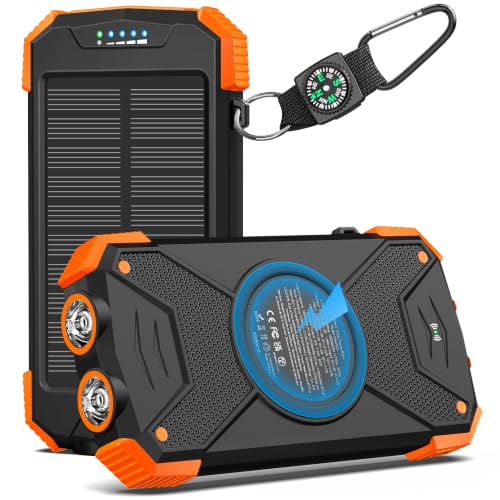
BLAVOR Solar Power Bank 10,000mAh Portable Wireless Charger for Cell Phones | 20W USB-C battery pack, battery bank, IPX5 waterproof, 2 flashlights, camping essentials, hiking gear, emergency solar backup


As an Amazon Associate we earn from qualifying purchases. Product prices and availability are accurate as of the date/time indicated.
Prices shown are approximate and for reference only. Prices change often, so please check the current price on Amazon before you buy.
Capacities and chemistries summarize manufacturers’ published information for current versions; verify the exact model’s figures at purchase. Ratings are editorial, weighing capacity per weight and dollar, charging speed and solar manners, output fit for camping, chemistry and longevity, and value.
The Six Camping Battery Packs Reviewed
1. Jackery Explorer 300 Plus: Best Overall
The 300 Plus is the small station done right for camping: LiFePO4 chemistry in a package light enough to carry from the car without a plan, capacity in the class that covers a weekend’s phones, lights, camera, and laptop with margin, AC and USB-C outputs that match the modern kit list, and Jackery’s solar pairing, which is the most camper-tested ecosystem in the category. Its fast home charging makes the pre-trip top-up an hour’s errand, its build tolerates the tent corner and the tailgate, and its size discipline is its virtue: it is the station that gets brought, because the bigger ones get debated. For the car camper and the basecamp family whose loads are electronics rather than appliances, it is the default this guide defends, the honest middle of the market in a well-made box.
2. BLUETTI EB3A: Best Fast-Charging Small Station
The EB3A’s party trick is speed: its turbo AC charging refills it in the time a camp morning takes, which changes the road trip’s arithmetic entirely, the station topping up at the diner stop and the visitor center rather than rationing itself across the day. Around that trick sits a complete small station, LiFePO4 cells, a useful spread of outputs, an app that reports the bucket’s level honestly, and a UPS feature that serves the home office between trips. Its capacity is the class’s smaller end, so the arithmetic in this guide’s opening governs its buyers strictly, and its fan makes its presence known under load in a quiet tent. For the camper whose trips are stitched together with driving and outlets, it is the cleverest buy in the table.
3. EcoFlow RIVER 2 Max: Best for Longer Trips
The RIVER 2 Max doubles the small stations’ bucket while keeping the weight in the one-handed class, which makes it the long weekend and small group answer: five hundred watt-hours across phones, a drone’s fleet of batteries, the camera system, lights for the whole camp, and a laptop’s working days, with EcoFlow’s fast charging and LiFePO4 longevity underneath. Its solar input suits the basecamp panel that turns a four day trip into an indefinite one for electronics loads. It is more station than a solo minimalist needs and exactly the station a family or a photography camp consumes without rationing, and its price per watt-hour is the table’s quiet bargain. Buy it when the load list, honestly written, says the small class will be counted out loud by the third night.
4. Anker SOLIX C300: Best USB-C Focused Station
The C300 is the station for the camp that has already converted to USB-C: a bank of modern ports with serious wattage, LiFePO4 capacity in the small class, a carry design that acknowledges it will be moved around the camp like furniture, and Anker’s fit and finish, which in this category means ports that feel like they will survive the decade the cells promise. Its AC output serves the occasional appliance of the electronic kind, the pump and the charger, while its heart is clearly the cable ecosystem the modern camper already owns. For the tent whose kit list contains no legacy plugs at all, it is the most native-feeling station in the table, and its app and display report the bucket’s state with Anker’s usual clarity.
5. Goal Zero Venture 75: Best Backpacking Power Bank
The Venture 75 is the pack for the pack: seventy-one watt-hours in a rugged, weather-rated shell that shrugs at the rain its owner cannot avoid, with USB-C delivery strong enough for phones and tablets and a build meant to live in a lid pocket for seasons. It charges a phone several times, a headlamp for a month of nights, and asks in return a weight the backpacker counts in ounces and accepts. Goal Zero’s solar panels pair with it for the long trail’s trickle, and its two ports end the nightly negotiation in a two person tent. It will not run a laptop’s working week or anything with a plug, and it does not pretend to, which is the honesty this guide rewards: it is the backpacking class’s complete answer, and the car campers should look up the table while the walkers look no further.
6. Anker PowerCore 737: Best Phone and Laptop Power Bank
The 737 is the power bank as a precision instrument: eighty-six watt-hours under the airline limit, USB-C output strong enough to charge a real laptop at speed, a display that reports the bucket in numbers rather than in four ambiguous dots, and a build that belongs in the work bag between trips. At camp it is the phone and camera bank for the weight-conscious car camper and the emergency reserve for everyone, the pack that lives in the glovebox and the daypack and forgives being forgotten until the night it is needed. Its price per watt-hour is the table’s steepest, buying output quality and intelligence rather than bulk capacity, and the camper whose loads include a laptop away from the car will find the trade written in its favor.
Buying Guide: How to Choose the Best Portable Lithium Battery Pack for Your Camping
Step One: Do the Load Arithmetic in Writing
List every device, its battery size or draw, and its nightly need, phones at roughly fifteen watt-hours per full charge, headlamps a few, camera batteries ten to twenty each, a drone’s battery fifty to eighty, a laptop fifty to one hundred per charge, and medical devices by their labels and your clinician’s and manufacturer’s guidance, tested at home across a full night before any trip. Multiply by nights without charging, divide by 0.85 for the conversion tax, and add a quarter for the margin that weather and generosity consume. The total names your class: under one hundred watt-hours, the power banks; one hundred to four hundred, the small stations; beyond that, the RIVER 2 Max’s class or a rethink of the loads. This arithmetic, ten minutes with a pencil, is the difference between the camper who rations and the camper who relaxes, and no review, including this one, can do it for you because no review knows your kit.
Step Two: Choose Chemistry, Charging, and Outputs as a System
Decide the chemistry by the carrying: LiFePO4 for the car and basecamp, where its thousands of cycles and heat tolerance compound across seasons; lithium-ion for the backpack, where pounds outrank decades. Decide the charging by the itinerary: drivers take the fast AC and the twelve volt top-up; basecampers take solar seriously and size the panel at double the naive figure, verified against the station’s input ceiling and connector; backpackers take the wall charge at the trailhead town and the small panel as a bonus rather than a plan. Decide the outputs by the kit’s plugs, USB-C power delivery for the modern list, AC for the chargers and pumps and medical devices, twelve volt for the legacy gear, and confirm the station’s AC wattage against your largest single load, since a station that cannot start the pump it was bought for is a paperweight with a display.
Step Three: Care for the Pack Like the Investment It Is
Store the pack half charged in a cool, dry place between trips, the lithium chemistries’ preferred retirement, and top it before each trip rather than storing it full against the calendar. Never charge it frozen: warm it inside the tent, the sleeping bag’s foot, or your jacket first, and in summer never leave it baking in a closed car, where cabin temperatures abuse cells and, in the extreme, become a hazard no camper should host. Keep the ports capped or the pack bagged against the camp’s dust and damp, use the cables it came with or their quality equals, and cycle it a few times a year even in the off season, a home movie night on the station counts, because packs that rest at the right charge and work occasionally are the ones still serving at the decade mark the LiFePO4 rows promise. A battery pack cared for this way is a ten year camping companion, which, divided across its price, makes it one of the cheapest comforts in the entire kit.
Frequently Asked Questions About Portable Lithium Battery Packs for Camping
What size battery pack do I need for a weekend of camping?
For the typical car camping weekend, two people, two phones charged nightly, headlamps, a lantern or string lights, and a camera, the honest total lands between one hundred fifty and three hundred watt-hours after losses and margin, which is precisely the small station class this table leads with, the 300 Plus and its peers covering it with room for the unexpected. Solo minimalists with a phone and a headlamp live happily on a seventy to one hundred watt-hour power bank, and the backpacking rows exist for them. Add a drone, a laptop’s work, a group’s worth of phones, or a fourth night, and the RIVER 2 Max’s five hundred class earns its weight. Medical devices rewrite the arithmetic entirely and conservatively: take the device’s nightly consumption, multiply by the nights, double it for margin, and test the whole arrangement at home first, because a battery question with health attached deserves an answer measured on your own driveway rather than estimated from an article.
Can I charge a lithium battery pack with a solar panel while camping?
Yes, and it is the basecamp’s path to independence for electronics loads, with the expectations set by physics rather than by the panel’s box. A panel delivers its rated watts only at a clear noon aimed at the sun; across a real day of angles, clouds, and camp shade, plan on collecting a few hours’ worth of the rating, which makes a one hundred watt panel a realistic match for a small station’s daily phone and light budget, repositioned a few times a day as the sun walks. Match the panel to the station’s solar input range and connector, favor the maker’s own pairing when in doubt, keep the station itself shaded and cool while the panel bakes, since heat is the cells’ enemy even as light is their food, and never let the arrangement charge a frozen pack on a winter morning before the sun has warmed the tent. Solar at camp is a harvest, not a utility, and the campers who treat it as one are never disappointed by it.
Can a portable power station run a CPAP or other medical device at camp?
Often yes, and it must be arranged with a seriousness the rest of this article’s loads do not require. Many CPAP machines run far more efficiently on their DC converter than through the station’s AC inverter, whose conversion tax can halve the night’s runtime, and heated humidifiers multiply the draw several times over, so the standard camping configuration, DC power, heat and humidity off, is the one to test. Test it at home, for full nights, on the exact station and settings you will carry, count the watt-hours consumed by morning, size the station at double the trip’s total need, and carry a backup plan appropriate to your health situation, which may include a second pack, the car, or a campsite with hookups, decided with your clinician’s input rather than an article’s. The stations in this table have made camp possible for many CPAP users who thought their tent years were over. The ones who succeed are, without exception, the ones who rehearsed at home.
How long will a lithium camping battery pack last over the years?
By chemistry and by care. LiFePO4 stations are rated in the thousands of full cycles to eighty percent capacity, which at a camper’s twenty to forty nights a year is a decade or more of service, and their calendar aging, slowed by the half-charge cool storage in this guide, is gentle enough that the ports and fans may age out before the cells do. Lithium-ion power banks are rated in the hundreds of cycles and age faster on the calendar, a realistic three to five years of strong service, which suits devices that turn over with the phones they charge. Both chemistries are shortened by the same abuses, charging frozen, baking in cars, storing full or empty for seasons, and both are lengthened by the rituals in the buying guide. Judged per year of service, the LiFePO4 station is the cheapest power this site has ever recommended, which is why the table’s center of gravity sits on that chemistry and why the care instructions deserve the same attention as the purchase.
Related guides
- Best Wine Coolers for 50 Bottles in 2026: 6 Wine Coolers With a Capacity of 46 to 52 Bottles, Dual Zone, and a Temperature Range of 40 to 65 Degrees Fahrenheit, for 50 Bottles, Without a Cooler That Is Too Small, or Too Big, for 50 Bottles
- Best Stove for Kayak Camping in 2026: 6 Best Stove for Kayak Camping Picks for Light Weight, Fast Boils, and Reliable Kayak Use
- Best Cooler Storage Mistakes Beginners in 2026: Best Cooler Storage Mistakes Beginners for Clean Storage, Safe Food, and Simple Camping Use
- Best Kayak Camp Hammock in 2026: 6 Kayak Camp Hammocks With a Weight of Less Than 2 Pounds, a Capacity of at Least 250 Pounds, and a Length of at Least 9 Feet, for Kayak Camping, Without a Hammock That Is Too Heavy, or Too Small, for a Kayak Camp
More from Amazon
Programs that pair well with the guide above. Offers and eligibility are set by Amazon and may change.
Free shipping on eligible items, Prime Video and more. Eligible new members can start with a free trial.
Start a Prime free trialA Prime membership for ages 18-24 with a trial period. Eligibility is set by Amazon.
See Prime for Young AdultsAudiobooks and podcasts to listen to on the go. Eligible new members can start with a free trial.
Try Audible freeAd-free music streaming. Eligible new subscribers can start with a free trial.
Try Music Unlimited freeAs an Amazon Associate we earn from qualifying purchases.

Write Your Review
No reviews yet. Be the first to share your experience!