
What's inside
As an Amazon Associate I earn from qualifying purchases. This post may contain affiliate links at no extra cost to you.
The best battery operated backpack sprayer replaces the most hated job in land and camp care, the endless hand pumping that left your arm shaking and your spray pattern pulsing, with a steady electric pump that holds pressure from the first tree ring to the last fence post. For a campground owner, a rural camp, a homestead, or the volunteer crew that keeps a group camp and its trails in order, that steadiness is not a luxury. It is even coverage, correct application rates, and a job finished in a morning instead of a weekend. But a battery sprayer is also a chemical applicator that you wear on your back, four gallons of liquid weighing roughly forty pounds all-in, with a battery, a pump, seals, and a wand that must all agree with each other and with the liquid you put in the tank. The wrong purchase leaks down your back, clogs on the second tank, dies with a proprietary battery you cannot replace at the local store, or sprays a fine, drifting mist on a breezy day when the label demanded coarse droplets. This guide compares real, currently sold battery backpack sprayers on pump pressure and flow, battery platform and runtime per charge, tank and seal materials, nozzle selection, strap and frame comfort, and the cleaning discipline that decides whether any sprayer lives for one season or for ten.
Two frames govern everything that follows, and they come before any model is praised. The first is the label. In the United States and most other jurisdictions, the product label of whatever you spray, herbicide, insecticide, fungicide, fertilizer, or plain soap and water, is a legal document: it specifies the application rate, the droplet and pressure requirements, the personal protective equipment, the wind limits, the setbacks from water, wells, gardens, and occupied areas, and the disposal rules. The sprayer is only a tool for following that label, and no recommendation in this guide outranks it. Keep people and pets, especially children, out of treated areas for the label’s stated interval, store chemicals locked and in their original labeled containers, never in food or drink bottles, and never mix products unless the labels expressly allow it. The second frame is honesty about the job. A backpack sprayer is for spot and band application over ground you can walk: weed control around tent pads, gravel, and fire rings where the label allows, orchard and garden rows, fence lines, invasive species work on trails, applying cleaning solutions to camp buildings and shower houses, and watering or feeding where a hose cannot reach. It is not a pressure washer, not a firefighting tool, never a container for fuel or any flammable liquid, and never, unless the maker expressly rates the exact model for it, a drinking-water carrier. Buy it for the walking work, use it by the label, and it will earn its place in the camp shed for years.
Our Top Picks
Best Battery Operated Backpack Sprayer: Pressure, Battery Platform, and Seals
Pressure, Flow, and Nozzles: Coverage Is a System
A sprayer is specified by the pressure it can hold, commonly in the class of 40 to 90 PSI across this table, by its flow rate in gallons per minute or per hour, and, most importantly in the field, by the nozzles it ships with and accepts. Pressure alone does not make coverage: a fan nozzle at its rated pressure lays an even band for weed work, a cone nozzle wets foliage in a garden, a jet or stream nozzle reaches height and distance at the cost of control, and a foaming nozzle stretches cleaning solutions on vertical surfaces. Adjustable-pressure models earn their premium because the label’s world is varied: lower pressure and coarse droplets for herbicides near desirable plants and on any day with air moving, higher pressure for reaching into brush and up into small trees where the label directs. The pump type matters to longevity, diaphragm pumps being the category’s standard for chemical tolerance and for running the mixed, gritty reality of camp chemicals, provided the tank’s strainer and the inline filter are actually cleaned, since most field failures blamed on pumps are starvation and clogging upstream of them. Grade any candidate by its nozzle kit, its filter access, and whether standard TeeJet-class tips fit it, because a sprayer that accepts the industry’s nozzle parish can be tuned to any label, while a proprietary-tip sprayer is limited to the tips in its box forever.
Battery Platform: The Decision You Live With Longest
The battery is the purchase inside the purchase, and it should be chosen like a platform, because it is one. The tool-brand sprayers in this table, Ryobi’s 18V ONE+, Milwaukee’s M18, and DeWalt’s 20V MAX class, draw on battery families that may already live in your camp’s drill, saw, and lantern chargers, which means spare batteries on the shelf, a charger that is already plugged in, and a replacement in any hardware store in America. Their sprayers are commonly sold bare, without battery and charger, at prices that are a bargain if you own the platform and a ambush if you do not, so the table’s ranges must be read with that condition attached. The dedicated sprayer brands, Chapin, FlowZone, PetraTools and their parish, ship with their own batteries and chargers in the box, simpler to buy and to gift, with runtimes commonly stated in gallons per charge, often in the class of several dozen gallons for the larger packs, and with replacement batteries ordered from the maker rather than grabbed off a shelf. Runtime claims deserve the same skepticism as cooler and lantern figures elsewhere on this site: they are measured with water, a modest nozzle, and a fresh battery, and thick mixes, high pressure, and cold weather all tax them. The cold rule from every lithium guide applies here too: never charge a lithium battery below freezing, and warm a cold pack before charging, because a sprayer battery killed by a January charge in an unheated shed is a spring discovery this paragraph exists to prevent.
Tank, Seals, Straps: Carrying Four Gallons Honestly
Four gallons of water weighs about thirty-three pounds before the sprayer itself is counted, so the carrying system is a safety specification and not a comfort extra: wide, padded shoulder straps, a padded back panel, a waist or sternum strap that actually bears load, and a frame that keeps the tank’s parish off the spine’s parish. Try the fit loaded with plain water before the first chemical job, walk your actual ground, and adjust until the load rides on the hips and not on the neck, because a sprayer that hurts will be set down, hurried with, and spilled. The tank should be translucent with honest gallon markings for mixing, wide-mouthed enough to pour and to clean, and fitted with a strainer basket under the cap. Seals are the chemical question: Viton-class seals are the parish rated for the widest range of chemicals, and the maker’s chemical compatibility guidance for the exact model governs what may go in the tank, with some solvents and aggressive products excluded from whole sprayer lines. Read that guidance before the first mix, not after the first leak, and keep a dedicated sprayer for herbicides if you also spray gardens, since residue discipline is cheaper than a dead tomato row, a lesson every experienced camp keeper has either learned or taught.
Best Battery Operated Backpack Sprayer: Quick Comparison
| Battery Backpack Sprayer | Key Specs | Best For | Typical Price Range | Rating |
|---|---|---|---|---|
| Milwaukee M18 Switch Tank 4 Gallon | Interchangeable tank class positioning, adjustable pressure in line, M18 battery platform, sold bare in line | Best battery operated backpack sprayer overall | $300 – $400 bare, by configuration | 4.7 / 5 |
| Ryobi 18V ONE+ 4 Gallon Backpack Sprayer | 4-gallon class positioning, ONE+ battery platform in line, adjustable nozzle parish | Best for existing Ryobi owners | $130 – $200 bare, by configuration | 4.5 / 5 |
| DeWalt 20V MAX 4 Gallon class | 4-gallon class positioning, 20V MAX platform in line, internal harness parish | Best for DeWalt platform camps | $200 – $300 bare, by configuration | 4.5 / 5 |
| FlowZone Typhoon / Cyclone 2.5 class | 4-gallon class positioning in Typhoon line, variable pressure in line, dedicated battery in box | Best dedicated sprayer performance | $280 – $380 by model | 4.6 / 5 |
| Chapin 24V 4 Gallon class | 4-gallon class positioning, dedicated 24V battery in line, established sprayer maker parish | Best established sprayer brand | $180 – $260 by configuration | 4.3 / 5 |
| PetraTools HD4000 class | 4-gallon class positioning, dedicated battery in line, long hose and cart options in parish | Best value dedicated kit | $170 – $250 by configuration | 4.2 / 5 |
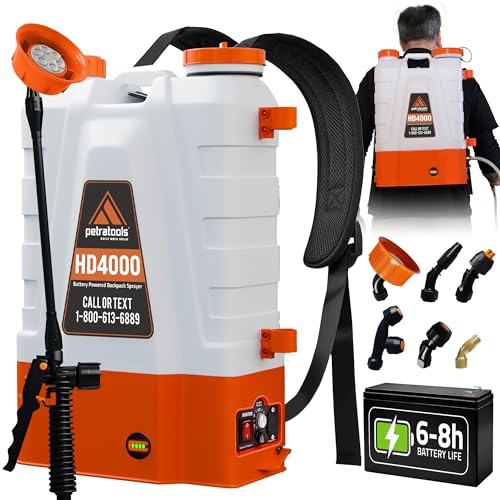
PetraTools HD4000 Battery Powered Backpack Sprayer, 6 Hr Runtime, 6 Nozzles | Electric Sprayer for Lawn & Garden w/ Battery Meter, Adjustable 90 PSI & Padded Straps - For Weed/Pest Control, Fertilizing
As an Amazon Associate we earn from qualifying purchases. Product prices and availability are accurate as of the date/time indicated.

Battery Powered Backpack Sprayer with Agitator, 120 PSI Fingertip Pressure Control, 4.0Ah Battery Operated Weed Sprayer with Telescopic Wand & 5 Nozzles for Lawn & Garden
As an Amazon Associate we earn from qualifying purchases. Product prices and availability are accurate as of the date/time indicated.

5.3Gal Battery Powered Backpack Sprayer for DeWalt 20V Battery Not Included | Built-in Mixing System, Adjustable 45–90 PSI Pressure, 39" Telescopic Wand, 6 Sprayer Nozzles for Lawn, Garden, Yard, Weed
As an Amazon Associate we earn from qualifying purchases. Product prices and availability are accurate as of the date/time indicated.
Prices shown are approximate and for reference only. Prices change often, so please check the current price on Amazon before you buy.
Pressures, flow rates, and gallons-per-charge figures refer to the makers’ published specifications for the exact model and battery; bare-tool prices exclude battery and charger where noted. Chemical compatibility is governed by each maker’s guidance and the product label. Prices are typical US street ranges. Ratings are editorial for camp and land care, weighing pressure control, battery platform, seal and tank quality, carry comfort, and value.
The Six Battery Backpack Sprayers Reviewed
1. Milwaukee M18 Switch Tank: Best Overall
The Switch Tank leads on an idea the whole category should copy: the tank assembly separates from the powered base, so one base runs a chemical tank, a water supply tank, and a concrete tank in their parishes, and a contaminated or dedicated tank is a part, not a whole sprayer. Its pressure adjustment and M18 parish complete the case. Its bare price is the summit’s. For a camp that sprays seriously, it is the recommendation defended first.
2. FlowZone Typhoon Class: Best Dedicated Performance
FlowZone builds only sprayers and it shows in the pressure control, the nozzle parish, and the gallons-per-charge of its larger packs. Its batteries are its own, ordered from its parish, which the platform section grades knowingly. For the keeper whose spraying is a weekly liturgy, it is the connoisseur’s standing answer.
3. Ryobi ONE+ 4 Gallon: Best Platform Value
Ryobi’s sprayer is the parish’s best arithmetic for the millions of camps and homes already holding ONE+ batteries: honest pressure, a comfortable enough harness, and a price that assumes your charger exists. Its seals and tips are its tier’s, maintained by the cleaning liturgy. As the first battery sprayer for most properties, it closes the argument.
4. DeWalt 20V MAX Class: Best for Its Platform
DeWalt’s entry serves its platform’s citizens with the build seriousness its tools are known for, at its platform’s prices. Buy it because your batteries are yellow, which is a complete and respectable reason in this category. Its row is the platform doctrine’s proof.
5. Chapin 24V Class: Best Established Brand Kit
Chapin has made sprayers since before batteries were invited, and its electric parish ships complete, battery in the box, from a maker whose parts parish is deep. Its pressure parish is the modest end, graded in its office. For the buyer who wants one box and a known name, it stands.
6. PetraTools HD4000 Class: Best Value Kit
PetraTools bundles generously, hose, nozzles, and support that its owners praise, at the dedicated parish’s friendliest prices. Its long-term parts parish is younger than Chapin’s, stated plainly. As the value entry to serious spraying, it earns the table’s last row honestly.
Buying Guide: How to Choose a Battery Operated Backpack Sprayer
Step One: Write the Jobs, the Chemicals, and the Platform You Own
List the actual jobs, weed control on gravel and pads, garden and orchard work, cleaning solutions for buildings, invasive species on trails, and the products you will spray in each, from their labels. Check the candidate sprayer’s chemical compatibility against that list and its pressure and nozzle parish against the labels’ requirements, and strike any sprayer that fails either, however friendly its price. Then inventory the batteries your camp already owns, because platform gravity is real money: a bare sprayer on your platform commonly beats a complete kit on a new one across a five-year parish of batteries and chargers. Size the tank to the ground, four gallons being the standard because it is the most a back should carry, with smaller tanks the honest choice for small properties and smaller keepers.
Step Two: Fit It With Water, Test the Pattern, Read the Filters
Before any chemical is mixed, fill with plain water, don the sprayer, and walk your ground: straps adjusted, load on the hips, wand reaching both sides without a stretch, and no leak at the cap, the hose, or the tank’s parish after ten loaded minutes, since a water leak found now is a chemical leak prevented forever. Spray a pattern test on dry concrete, where the fan’s evenness, the cone’s coverage, and any nozzle’s spitting or streaking can be seen and the faulty tip replaced from the kit. Locate and remove every filter, tank strainer, inline filter, and tip screen, so their positions are learned at leisure rather than at a clog. Reject or return a sprayer whose harness cannot be made honest or whose filters cannot be reached, because you will live with those two facts on every tank you ever run.
Step Three: Mix, Spray, and Clean by the Liturgy
Mix outdoors, on a stable surface away from wells, water, and children’s parishes, wearing the label’s protective equipment, gloves and eye protection being the floor and not the ceiling, measuring with dedicated tools that never enter a kitchen, and adding chemical to water in the order the label directs. Spray in the label’s weather, commonly calm air, no rain imminent, and temperatures in range, keeping bystanders and animals clear for the label’s interval and minding drift onto gardens, water, and the neighbors’ parish as a legal and neighborly duty in one. Clean immediately after: empty and rinse by the label’s disposal rules, never pouring concentrate or rinsate into drains, wells, or waterways, run clean water through pump, hose, and every nozzle, wash the exterior, and store the sprayer dry, indoors, with the battery removed to its temperate parish and charged by the lithium rules, never below freezing. Log the job, product, rate, area, and weather, in the camp’s book. Kept so, a battery sprayer becomes what its pump promised, a season-after-season instrument of a well-kept camp, which is the whole doctrine of the best battery operated backpack sprayer and the reason the right one is chosen by its seals, its platform, and its owner’s discipline, and never by its tank’s size alone.
Frequently Asked Questions About Battery Backpack Sprayers
How long does a battery backpack sprayer run on one charge?
In the makers’ published classes, commonly enough for several tanks of spraying, often stated in gallons per charge in the range of a few dozen gallons for the larger dedicated packs and platform batteries in good condition, with the field’s figure taxed by the usual citizens: higher pressure settings, large-flow nozzles, thick or cold mixes, and an aging battery all spend the charge faster. The practical planning figure for a camp keeper is a morning’s work per battery, with a second battery on the charger for any job that matters, which is another argument for the platform sprayers whose spare batteries the camp already owns. Treat the battery with the lithium liturgy used throughout this site, charge it in a temperate place, never below freezing, store it partially charged across a long winter rather than full or empty, and replace it when its runtime falls to the parish where jobs are left unfinished, since a sprayer is a system and its battery is the part with a calendar.
Can I spray different chemicals in the same backpack sprayer?
You can, with a cleaning discipline that many experienced keepers judge too risky for one particular boundary, and the boundary is herbicides and everything else. Between different products generally, the sprayer must be emptied, rinsed, and flushed through pump, hose, and nozzles according to both labels, with some products requiring specific tank cleaners, and the rinsate disposed of as the label directs, never into drains or water. Across the herbicide boundary, the residue of a weed product in a sprayer later used on a garden or orchard can injure the very plants you are feeding, at concentrations a casual rinse can leave behind, which is why the standing practice in the professional parish is a dedicated, clearly labeled herbicide sprayer and a separate sprayer for the garden’s work, a duplication this guide endorses for any camp that does both. Whatever the product, a sprayer is labeled on its tank with its contents the moment it is mixed, it is never used for drinking water, and it is stored locked away from children and from food, because most sprayer accidents are not mechanical at all; they are identification failures that a strip of tape and a marker prevent.
Why is my battery sprayer losing pressure or spraying unevenly?
Work the parish in its usual order, because the cause is almost always humble: the filters first, the tank strainer, the inline filter, and the tip screen, any of which can starve a healthy pump into a pulsing, spitting shadow of itself; the nozzle second, worn, damaged, or partly blocked tips streak and fan unevenly and are consumables, not heirlooms; the battery third, since a tired or cold battery sags under load and the pump’s pressure sags with it, cured by a fresh, warm pack; and the seals and hose fourth, a perished O-ring or a hose drawing air at a fitting giving the classic symptom of a pump that runs and a pattern that will not build. The pattern test on concrete from Step Two is the diagnostic that separates these, and the cleaning liturgy is the prevention for most of them. A sprayer that still fails after filters, tip, and battery have been honestly cleared has earned its maker’s support line and its warranty parish, in that order, and not another season of hopeful shaking.
What protective equipment do I need when using a backpack sprayer?
The label of the product you are spraying decides, and it is the floor of your preparation rather than a suggestion to be averaged with habit: chemical-resistant gloves and eye protection are required by most labels for mixing and application, with long sleeves, long trousers, closed footwear, and, for some products and some application methods, a respirator or face shield specified in the label’s own words. Mixing is the highest-exposure moment and deserves the full parish even when the spraying itself is lighter, and the equipment is donned before the container is opened, not after the first splash. Wash hands and exposed skin as soon as the job ends, launder spray clothing separately, and shower after a long session, keeping the equipment itself clean and stored with the chemicals, locked, in their original labeled containers, away from children, animals, and food in every parish without exception. If a product’s requirements feel burdensome, the correct response is to choose a gentler product for the camp’s setting, soap, water, and mechanical weeding being the honest citizens they are, and not to wear less equipment than the chosen label demands.
Related guides
- Camping Cot: 6 Best Camping Cot Picks for Comfort in 2026
- Cooler Bag in 2026: The Complete Guide to Choosing a Soft Cooler Bag That Keeps Food Cold, From YETI Hopper and RTIC Soft Pack to Igloo and Hydro Flask, Sized by Your Real Load and Proven on a Thermometer
- Best Dutch Oven for Camping in 2026: Cast Iron Dutch Ovens That Cook Stews, Bread, and More
- Best Compact Tent for Small Cars in 2026: 7 Compact Tents That Offer Easy Packing, Light Weight, and Reliable Performance for Small Cars
More from Amazon
Programs that pair well with the guide above. Offers and eligibility are set by Amazon and may change.
Free shipping on eligible items, Prime Video and more. Eligible new members can start with a free trial.
Start a Prime free trialA Prime membership for ages 18-24 with a trial period. Eligibility is set by Amazon.
See Prime for Young AdultsAudiobooks and podcasts to listen to on the go. Eligible new members can start with a free trial.
Try Audible freeAd-free music streaming. Eligible new subscribers can start with a free trial.
Try Music Unlimited freeAs an Amazon Associate we earn from qualifying purchases.

Write Your Review
No reviews yet. Be the first to share your experience!