
What's inside
As an Amazon Associate I earn from qualifying purchases. This post may contain affiliate links at no extra cost to you.
The best air purifier for camper life is a small, honest machine matched to a small, honest space, and the matching is where most purchases go wrong. A camper, an RV, a travel trailer, or a van conversion holds a few hundred cubic feet of air, not a suburban living room’s thousands, so the desktop purifier that is a toy in a house becomes a genuine air-changer in a camper, turning the whole cabin’s air over many times an hour. But the camper adds constraints no house imposes: power is a budget, drawn from a battery bank, a small inverter, or a shore hookup that also runs everything else; storage is a ration, and a bulky tower purifier competes with the food; the air’s enemies are specific, road dust, pollen at the campground, campfire smoke that follows you inside, cooking vapor in a space the size of a closet, and the damp, closed-up smell of a rig that sat shut between trips. This guide compares six real, currently sold purifiers graded for camper duty specifically, wattage and 12-volt friendliness weighed beside filtration, and it opens with the honesty the category needs: a purifier filters particles and, with carbon, some odors and gases. It does not remove carbon monoxide, it does not fix a moisture problem, and it is never a substitute for ventilation and a working CO detector, which are the camper’s first air-quality appliances and are treated as such throughout.
Learn what the camper’s air actually contains before choosing its cleaner. The particle load is dominated by dust and pollen tracked and blown in, pet dander in the rigs that travel with their rightful owners, and smoke, both the campfire’s, which is ambiance outdoors and an infiltrator indoors, and cooking’s, which in a camper’s volume reaches concentrations a house kitchen never meets. True HEPA filtration is the tool for all of it, and the buyer should insist on the words true HEPA rather than the dialect of HEPA-type and HEPA-style that decorates the budget shelf. Odors and the stale closed-rig smell are a different chemistry, gases rather than particles, addressed by activated carbon in proportion to its weight, which is why the little purifiers’ thin carbon pads perfume the problem briefly while the models with a real carbon charge work at it for a season. Moisture is the third enemy and the purifier is not its opponent at all: a damp camper grows mold behind its walls that no filter can reach, and the answers are ventilation, leak repair, and a small dehumidifying discipline, with the purifier mopping up the spores the air carries once the source is governed. Buy in that order, dry and ventilated first, filtered second, and the machine in this table will perform like the finishing tool it is.
Our Top Picks
Best Air Purifier for Camper: Power Draw, Size, and True HEPA
Power: Watts, Inverters, and the Battery Bank’s Budget
Grade every candidate by its wattage before its CADR, because in a camper electricity is the rationed currency. The small purifiers in this table draw in the tens of watts and below, the minis sipping single digits to low teens, which is the difference between a machine that runs all night on the battery bank without a thought and one whose fan is a line item in the evening’s power audit beside the lights and the fridge. Most run on household AC through their adapters, so the boondocking rig feeds them through the inverter with its own overhead, a tax the smallest, USB-powered models avoid entirely by drinking from the same power stations and ports that charge the phones. Match the machine to the rig’s electrical life honestly: the shore-power camper may ignore this section and buy filtration first, while the dry-camping van should let wattage lead the decision and treat a USB-powered purifier’s modest output as the correct engineering for a few hundred cubic feet, which, turned over hourly all night, is precisely what the space requires. Solar-recharged power stations have made the small purifier a realistic boondocking citizen, provided its draw was counted in the system’s design rather than discovered in the dark.
Size, Noise, and Where a Purifier Lives in a Camper
A camper purifier’s home is a decision, not an afterthought: the counter’s corner, the dinette’s end, the shelf by the bed for the allergy sleeper who is its real constituency. Small footprints and a shape that tolerates the rig’s motion, low, stable, with controls that will not be changed by a elbow or a dog, are graded virtues here, and the machine should be secured or wedged for travel, since a purifier that tours the cabin on the first mountain grade is a projectile with a filter. Noise is the night specification: the camper’s bed is feet from the machine, so the sleep-speed decibels matter more than the turbo’s output, and the better small purifiers run their low settings in the whisper parish that doubles as white noise many campers sleep better with. Display lights deserve their sentence, since a bright LED in a dark camper is a nightlight nobody ordered, and models with dimmable or extinguishable displays grade higher for the sleeping rig. Filters close the audit: a camper purifier’s filter is a consumable on a shorter leash than a house unit’s, the dusty parish spending it faster, so price the replacement, confirm it is stocked by name, and prefer designs whose prefilter can be vacuumed or rinsed, stretching the HEPA’s life across the season.
What a Purifier Cannot Do in a Camper
Give the limits their own heading so no reader buys past them. A purifier does not remove carbon monoxide from a furnace fault, a generator’s drift, or a stove’s misuse, and it must never be counted in the camper’s CO defenses, which are a working, in-date CO detector, appliances maintained and vented as their makers direct, generators placed outside and downwind at distance, and ventilation whenever anything burns. It does not dry a wet rig, dehumidify a shower’s steam, or remediate mold growing inside a wall; it filters the air that passes through it, and mold’s source is a moisture problem whose repair is the actual cure. It does not meaningfully scrub cooking gas fumes or propane, whose answer is the vent fan and the open window. And its carbon, however good, is spent by smoke and odor on a schedule the campfire accelerates, so the camper who runs it nightly beside a smoky site should budget filters as a consumable of the lifestyle, like the firewood itself. Held inside those limits, the purifier is excellent. Asked to exceed them, it becomes a small fan with a false promise, in a small space where false promises about air are not a venial sin.
Best Air Purifier for Camper: Quick Comparison
| Camper Air Purifier Model | Key Specs | Best For | Typical Price Range | Rating |
|---|---|---|---|---|
| Levoit Core 300S | True HEPA in class, smart controls positioning in line, compact tower, low power in class | Best air purifier for camper overall | $150 – $190 | 4.6 / 5 |
| Levoit Core Mini | Compact in class, HEPA filtration positioning, very low power draw in line | Best for vans and small campers | $45 – $60 | 4.4 / 5 |
| Blueair Blue Pure Mini Max class | Compact in class, HEPASilent positioning in line, quiet low speed | Best quiet bedside purifier | $70 – $100 | 4.4 / 5 |
| Medify MA-14 | True HEPA in class, compact desktop size positioning, timer in line | Best value true HEPA | $70 – $100 | 4.3 / 5 |
| Pure Enrichment PureZone Mini | Portable in class, USB-powered positioning in line, travel size | Best USB-powered for boondocking | $35 – $50 | 4.1 / 5 |
| Winix Zero S class / larger compact | True HEPA in class, PlasmaWave positioning in line, higher output | Best for larger RVs on shore power | $200 – $280 | 4.3 / 5 |

Levoit Air Purifiers for Bedroom Home Pets Dorm Room, Small Air Purifiers | Filter Cleaner with Fragrance Sponge, Filters Smoke, Allergens, Pet Dander, Odor, Dust, Office, Desktop, Core Mini-P, White
As an Amazon Associate we earn from qualifying purchases. Product prices and availability are accurate as of the date/time indicated.

VOOPNU Air Purifiers for Home, High Efficiency Filter Up to 1076 Ft², White | for Pet Hair, Odors, Pollen, Smoke, Compact Air Cleaner with 3 Speeds, Timer, Aroma 22 dB Quiet 360°Intake, DH-JH12
As an Amazon Associate we earn from qualifying purchases. Product prices and availability are accurate as of the date/time indicated.
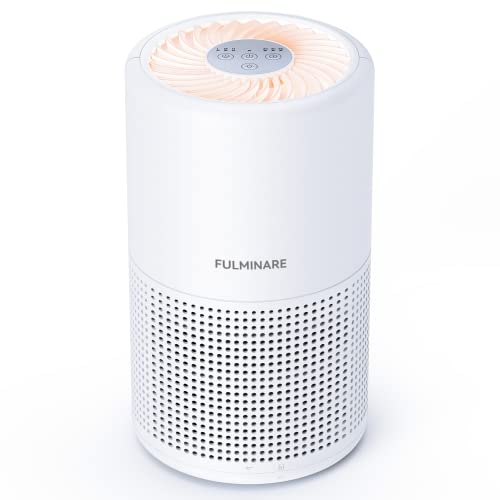
Air Purifiers for Bedroom, FULMINARE H13 True HEPA Filter Up to 1086 Ft² | Remove Pet Hair, Smoke, Odors, 20 dB Quiet Air Cleaner with Night Light, Portable Air Purifier for Home, Office, Living Room
As an Amazon Associate we earn from qualifying purchases. Product prices and availability are accurate as of the date/time indicated.
Prices shown are approximate and for reference only. Prices change often, so please check the current price on Amazon before you buy.
Room-size claims are makers’ figures for houses; in a camper’s small volume, effective air changes are far higher. Prices are typical US street ranges. Ratings are editorial for camper use, weighing filtration, power draw, size and noise, filter costs, and value in small RV spaces.
The Six Camper Air Purifiers Reviewed
1. Levoit Core 300S: Best Overall for Campers
The Core 300S leads on the union of true HEPA filtration, a carbon charge that genuinely works at the closed-rig smell, smart controls that let it be governed from the bunk, and a footprint that a camper counter can surrender. Its power draw is modest for its output, and in a camper’s volume its air changes are lavish. For the travel trailer and mid-size RV that camps on a mix of hookups and battery, it is the recommendation defended first.
2. Levoit Core Mini: Best for Vans and Small Campers
The Core Mini is the small rig’s correct engineering: a purifier the size of a water bottle with a draw so low the battery bank never notices it, filtration honest for its class, and a simplicity, one button’s parish, that suits a space with no room for ceremony. Its carbon is the mini class’s thin ration. In a van, a teardrop, or a truck camper, it may be all the purifier the volume requires, and its grade honors sufficiency properly matched.
3. Blueair Blue Pure Mini Max Class: Best Quiet Bedside
Blueair’s small class earns its row on the night: a low speed quiet enough for the pillow two feet away, filtration of the maker’s hybrid standard, and a fabric prefilter that vacuums clean at the campground and dresses the machine like furniture. Its controls are minimal. For the allergy sleeper whose camper air quality is measured at the bed, it is the night’s best citizen in this table.
4. Medify MA-14: Best Value True HEPA
The MA-14 delivers genuine HEPA in a compact desktop body at a price that lets the camper owner treat filters as consumables without resentment, with a timer that suits the evening’s cooking hour and the night’s first sleep cycle. Its fit and finish grade in its tier. For the budget rig that refuses HEPA-type imitations, it is the thinking purchase.
5. Pure Enrichment PureZone Mini: Best USB-Powered
The PureZone Mini is the boondocker’s specialist: USB-powered, drawing from the power station, the laptop port, or the rig’s USB panel, small enough for the glovebox between trips, with filtration graded honestly as the portable class’s. It will not clear a smoky evening quickly. Running all night for nearly no power in a small van, it does the quiet work its parish asks, and closes the table’s low end with its niche honestly served.
6. Winix Zero S Class: Best for Larger RVs on Shore Power
The larger compact class, Winix’s Zero S its representative, serves the big fifth-wheel and the park-model life: output for a real living area, true HEPA with a serious carbon stage, and features the hookup’s power makes free. It is too large and too thirsty for the van parish and says so by its dimensions. Where the rig is a small apartment that happens to have wheels, it is the right scale of machine.
Buying Guide: How to Choose an Air Purifier for Your Camper
Step One: Fix the Rig’s Air Problems in the Right Order
Before any purifier is chosen, govern the sources: confirm the CO detector is present, in date, and tested, repair the leaks and govern the moisture that feed the closed-rig smell and the mold behind it, and establish the ventilation habit, the vent fan for cooking and showers, the cracked window for the night, that is the camper’s primary air system. Then write the purifier’s actual job in one line: the allergy sleeper’s pollen, the full-timer’s dust, the smoke that follows the campfire in, the pet’s contribution, since that job elects the model’s filtration weight, carbon’s importance, and placement. Measure the space it must live in and the power it may spend, in watts against your bank’s honest budget, and let those two numbers, shelf and watts, strike the house-sized candidates from the list before filtration is even discussed.
Step Two: Buy True HEPA, Priced With Its Filters
Require the words true HEPA on the exact model, treat HEPA-type as the absence it is, and weigh carbon by its physical presence, a substantial cartridge over a scented pad, where odor and smoke are in your job description. Price the whole first year in the same arithmetic: the machine, a season’s replacement filter at the camper’s accelerated schedule, and the electricity where it is metered by the battery’s size, and prefer the model whose filters are stocked by name from more than one seller, since a purifier orphaned by its consumable is a fan by Christmas. Confirm the sleep-speed noise and the display’s ability to go dark in the product’s documentation rather than in its photographs, and check the travel question, size, stability, a home it can be secured in, against your rig’s actual motion.
Step Three: Run It as a System, All Season
Place the purifier where its intake breathes freely, by the bed for the allergy parish, central for the dust parish, never sealed in a cabinet whose door makes its output a rumor, and run it on the schedule the job dictates: continuously on low for the full-timer, the evening and night for the weekend rig, turbo for the cooking hour and the smoke’s invasion, then back to the whisper. Keep its prefilter vacuumed at every campground with a hookup and its HEPA replaced on evidence and on the calendar, and pair it always with its senior partners, the vent fan during cooking, the window’s crack at night, the detector’s green eye over all. Between trips, store the rig dry and ventilated where possible, with the purifier’s own filter protected from the closed-up weeks that spend it on stale air. Run so, a camper’s air becomes a managed system rather than a hope, and the little machine on the counter earns its shelf the way everything in a camper must, by being exactly as large, as thirsty, and as capable as the small, honest space requires.
Frequently Asked Questions About Air Purifiers for Campers
Can an air purifier protect my camper from carbon monoxide?
No, and this is the most important answer in the article. Consumer air purifiers, HEPA and carbon alike, do not remove carbon monoxide to any protective standard, and no purifier should ever be counted as part of a camper’s CO safety. That duty belongs to a working, in-date carbon monoxide detector, tested and replaced on its maker’s schedule; to furnaces, stoves, and water heaters maintained and vented as designed; to generators run outside, well away from and downwind of the rig, never in a vestibule or under an awning; and to ventilation whenever fuel burns. If a CO alarm sounds, the drill is air and exit, get everyone outside into fresh air and call for help, not a faster fan speed. Buy the purifier for dust, pollen, and smoke with a clear conscience, and keep the detector’s parish entirely, sacredly separate.
What size purifier does a camper actually need?
Far smaller than house marketing implies, because air changes are volume divided by output and a camper’s volume is a few hundred cubic feet. A compact purifier rated for a small bedroom will turn a camper’s entire air over many times per hour, which is more than sufficient for dust and pollen duty, and even the mini class serves a van or truck camper genuinely. Buy by the constraints that actually bind in a rig, the shelf it must live on, the watts it may draw, the noise at pillow distance, rather than by chasing house-sized CADR figures, and step up to the larger compact class only for the big fifth-wheels and park models whose living areas approach a studio apartment’s. The right size is the one that runs all night, every night, without a thought about power or space, since consistency, not peak output, is what cleans a small space’s air.
Will a camper purifier remove campfire smoke and cooking smells?
Particles, yes, thoroughly: smoke is particulate, HEPA catches it, and a small purifier in a camper’s volume clears a smoky evening’s infiltration visibly and measurably over an hour’s running. Smells are the harder half, being gases that only the carbon stage addresses, in proportion to the carbon’s weight and freshness, so the models with a real carbon cartridge will take the campfire and the cooking down substantially while the minis’ thin pads make a brief gesture. Help the machine like a partner: close the rig against the smoke while the fire is at its height, run the vent fan during cooking rather than after it, and accept that a purifier asked to fight an open window beside a campfire is bailing a boat with the seacock open. Budget the carbon’s replacement on the smoky season’s schedule, since smoke spends it fastest of all the camper’s airs.
Can I run a camper air purifier on battery power while boondocking?
Yes, with the wattage counted like the currency it is. The mini and USB-powered class draws so little, single digits to low teens of watts, that a modest battery bank or power station runs one all night without noticing, which is why those models lead the dry-camping parish of this guide. The larger compacts draw in the tens of watts through an inverter that adds its own overhead, a real line item to plan beside the fridge and the lights rather than a surprise to discover at midnight. Do the evening’s arithmetic before the trip: the bank’s usable watt-hours against the night’s whole load, purifier included, with a margin for the cold night that makes every battery smaller. Run so, the boondocker sleeps in filtered air on solar gathered at noon, which is the camper life working exactly as its brochures promised.
Related guides
- Best Sea Kayaking Backpack Trip Pacific NW: 6 Best Sea Kayaking Backpack Trip Pacific NW Picks in 2026
- Best Tandem Kayak for Camping in 2026: Two-Person Boats With the Hatch Space and Stability for Multi-Day Trips
- Best Camp Cutting Board Material Durability Guide in 2026: 6 Boards That Resist Cuts, Warping, and Camp Wear
- Best Battery Operated Camping Lights in 2026: Best Battery Operated Camping Lights for Bright Light, Good Battery Life, and Simple Camping Use
More from Amazon
Programs that pair well with the guide above. Offers and eligibility are set by Amazon and may change.
Free shipping on eligible items, Prime Video and more. Eligible new members can start with a free trial.
Start a Prime free trialA Prime membership for ages 18-24 with a trial period. Eligibility is set by Amazon.
See Prime for Young AdultsAudiobooks and podcasts to listen to on the go. Eligible new members can start with a free trial.
Try Audible freeAd-free music streaming. Eligible new subscribers can start with a free trial.
Try Music Unlimited freeAs an Amazon Associate we earn from qualifying purchases.



Write Your Review
No reviews yet. Be the first to share your experience!