
What's inside
As an Amazon Associate I earn from qualifying purchases. This post may contain affiliate links at no extra cost to you.
The best tandem kayak for camping solves a packing problem that a pair of solo boats never faces: two paddlers, one hull, and a weekend’s or a week’s worth of shelter, food, and clothing that must disappear into hatches sized by a naval architect who assumed you would travel light. A tandem earns its keep on a camping trip for honest reasons. It halves the roof load and the shuttle problem, it lets a stronger paddler carry a newer one, it puts partners, parents and kids, or a paddler and a dog in one conversation instead of two boats drifting apart, and it can carry a genuinely luxurious camp, the big tent, the real cooler, the two-burner stove, that solo ultralight discipline forbids. It also has honest costs, and this guide will name them: a tandem is heavier to cartop, slower to turn, and famously a relationship instrument, because two people supplying one boat’s steering will discover everything about their communication by the second bend in the river. Choose it with open eyes, load it correctly, agree on who steers before you launch, and a tandem is the finest camping vehicle on flat and slow-moving water. Dress for immersion, wear the PFD, file a float plan, and learn the wet exit and re-entry together in warm shallows before the first trip, because a camping tandem capsized with a weekend of gear aboard is a logistics problem you want to have rehearsed.
Camping capacity is the first filter, and it is measured in two numbers that listings blur together. Weight capacity is the hull’s total honest load, paddlers plus gear plus the boat’s own margin, and a camping tandem should hold its crew and fifty to a hundred pounds of camp without sitting so low that every ripple boards over the cockpit rim. Storage volume is the second number, split between sealed hatches with bulkheads, which keep gear dry and provide flotation, and open tankwells, which swallow a cooler or a dry bag but leave it to the weather. For multi-day work, two bulkheaded hatches, bow and stern, are the architecture that matters, because they divide the load, protect the sleeping gear in a capsize, and let you trim the boat by moving weight toward the middle. Sit-on-top tandems trade that sealed storage for self-draining simplicity and easy re-entry, and they camp beautifully on warm water with everything in dry bags; sit-inside tandems carry more, drier, and faster, and ask more skill when things go wrong. Neither parish is wrong. Match the boat to your water, your season, and your crew’s swimming confidence, and the rest of the specifications fall into line behind that decision.
Our Top Picks
Choosing the Best Tandem Kayak for Camping: Capacity, Hatches, and Hull Manners
Sit-On-Top vs Sit-Inside for Camp Loads
The sit-on-top tandem is the warm-water camper’s friend: a self-bailing deck you can climb back onto from a swim, a big rear tankwell that takes a cooler or a crate of dry bags, and no cockpit to fill when a wave boards. Its camp gear lives in dry bags on deck, which is fine in July and a discipline in October, and its width gives it the primary stability that lets a nervous partner relax and a dog reposition without ceremony. The sit-inside tandem is the expedition tool: lower, faster, and drier, with bulkheaded hatches that swallow a tent and two sleeping kits below deck, a spray skirt option for cold or rough water, and a hull that tracks through wind instead of being pushed by it. Its price is a harder re-entry after a capsize and a cockpit that must be pumped or emptied ashore. For sheltered lakes and slow rivers in summer, either camps well; for shoulder seasons, big water, or week-long loads, the sit-inside’s sealed volume is the safer architecture, and for beginners camping with kids in warm water, the sit-on-top’s forgiveness usually wins the argument.
Trim, Rudders, and the Steering Conversation
A loaded tandem trims like a seesaw, and the crew that ignores it paddles a boat that wanders or weathervanes all day. The heavier paddler belongs in the stern, where the steering strokes live; the camp load belongs low and centered, heavy items near the middle bulkheads rather than at the ends, because weight in the bow and stern makes the hull pivot slowly and hobby-horse in chop. Test the trim in the shallows at launch, adjust the load before you commit, and re-check it after the first water stop, because a boat that will not hold a line is usually a loading error, not a hull defect. A rudder, standard or optional on the better camping tandems, is worth its cost on open water and windy lakes: it lets the stern paddler steer with their feet and save their strokes for propulsion, which over a fifteen-mile day is the difference between tired and wrecked. Agree on the parish rules before launching, the stern steers, the bow sets the cadence, either voice can call a stop, and you will have pre-empted the argument that gives tandems their nickname.
Seats, Weight, and Getting It to the Water
Two people sitting for five hours will grade the seats more harshly than the hull, so treat seat quality as a primary specification: framed, elevated, breathable seats on the fishing-derived tandems transform a day’s comfort, while molded seats with add-on pads serve shorter trips honestly. Then respect the logistics nobody lists: a camping tandem runs from roughly sixty to over a hundred pounds, which means two-person carries, a cart for the portage from car to shore, and a roof system rated for the load, with loading assistance or a hull lifter if the vehicle is tall and the crew is not. The romantic part of kayak camping is the shoreline at dusk; the part that ends trips early is a boat that is miserable to move on land. Buy the cart in the same order as the boat, practice the cartop load in the driveway, and the water will be the easy part.
Best Tandem Kayak for Camping: Quick Comparison
| Tandem Kayak Model | Key Specs | Best For | Typical Price Range | Rating |
|---|---|---|---|---|
| Wilderness Systems Pamlico 145T | Sit-inside in class, two bulkheaded hatches positioning, sliding bow seat in line | Best tandem kayak for camping overall | $1,100 – $1,400 | 4.7 / 5 |
| Old Town Twin Heron | Sit-inside in class, removable front seat for solo use positioning, generous cockpit | Best for partner-plus-solo flexibility | $900 – $1,150 | 4.5 / 5 |
| Ocean Kayak Malibu Two XL | Sit-on-top in class, large tankwell positioning, overlapping seating for a small third passenger | Best warm-water family camper | $800 – $1,050 | 4.5 / 5 |
| Perception Rambler 13.5 | Sit-on-top in class, molded seats positioning, friendly pricing in line | Best budget tandem for camping | $550 – $750 | 4.3 / 5 |
| Hobie Mirage Compass Duo | Pedal-drive in class, framed seats positioning, kick-up fins in line | Best pedal tandem for long camp days | $3,200 – $3,800 | 4.6 / 5 |
| Advanced Elements AdvancedFrame Convertible | Inflatable in class, converts tandem to solo positioning, packs into a duffel | Best for storage and travel | $900 – $1,200 | 4.3 / 5 |

BKC Brooklyn 13.5 Tandem Pedal Fishing Kayak, 2 Person | Dual flipper pedal drives, rudder steering, 680 lb capacity, sit-on-top hull, gear storage, for fishing and touring
As an Amazon Associate we earn from qualifying purchases. Product prices and availability are accurate as of the date/time indicated.
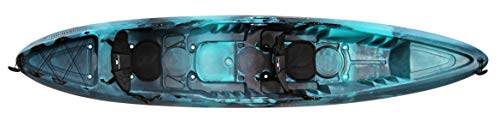
Perception - Rambler 13.5 Recreational Kayak - Sit on Top Tandem Kayak - Storage with Tie Downs - 13.6 ft - Dapper
As an Amazon Associate we earn from qualifying purchases. Product prices and availability are accurate as of the date/time indicated.

INTEX Excursion Pro K2 Inflatable Kayak 2-Person Set with Paddles & Pump | 68309EP - Portable Sit-on Tandem Kayak with Removable Skegs and Two Dry Bags for Gear, 12ft 9in x 3ft
As an Amazon Associate we earn from qualifying purchases. Product prices and availability are accurate as of the date/time indicated.
Prices shown are approximate and for reference only. Prices change often, so please check the current price on Amazon before you buy.
Capacities, hatch configurations, and weights refer to the makers’ published specifications for the exact model; verify the total load capacity against your crew and gear before purchase. Prices are typical US street ranges. Ratings are editorial for tandem kayak camping, weighing sealed storage, total capacity, comfort, tracking under load, and value.
The Six Tandem Camping Kayaks Reviewed
1. Wilderness Systems Pamlico 145T: Best Overall
The Pamlico leads on the expedition architecture: two sealed hatches, a hull that tracks honestly under a camp load, and a sliding bow seat that lets the crew tune their legroom and trim. It is a real boat to cartop and wants the cart of the text. For couples camping beyond the weekend, it is the recommendation defended first.
2. Hobie Mirage Compass Duo: Best Pedal Tandem
The Compass Duo trades paddles for pedals and buys the long day: two drive units, framed seats, and hands free for the camera, the fishing rod, and the snack bag. Its price and weight are the summit’s, confessed plainly. On big lakes where the miles are the trip, it is in a class of one.
3. Ocean Kayak Malibu Two XL: Best Family Camper
The Malibu Two XL is the warm-water parish’s institution: a stable sit-on-top whose middle seat carries a small child or a dog, with a tankwell that swallows the cooler. Its camp gear rides in dry bags and its pace is the holiday’s. For summer family camping, it is the standing answer.
4. Old Town Twin Heron: Best Flexible Seating
The Twin Heron’s removable front seat converts the boat to a spacious solo, which answers the household whose partner sometimes stays ashore. Its open cockpit loads easily and camps generously in sheltered water. As two boats in one hull, it is the diplomat of the table.
5. Perception Rambler 13.5: Best Budget
The Rambler puts a sound, stable tandem at the friendliest price in the table, with molded seating that suits the shorter day. Its storage is the open parish’s, dry bags required. For the first camping season, its arithmetic is the argument.
6. Advanced Elements AdvancedFrame Convertible: Best for Storage
The Convertible inflates, which solves the apartment, the small car, and the no-roof-rack problems in one duffel, and its built-in ribs give it manners above the pool-toy parish. It packs a camp in dry bags and packs away in a closet. For the storage-poor camper, it is the only door into this sport.
Buying Guide: How to Choose a Tandem Kayak for Camping
Step One: Weigh the Crew and the Camp, Then Shop Capacity
Add the paddlers’ weights, the camp’s honest weight, tent, bags, pads, food, water, stove, and a margin for the wet and the souvenirs, and shop only boats whose rated capacity clears that total with room to float high. Confirm the storage architecture against your longest trip: two bulkheaded hatches for the multi-day sit-inside parish, or a tankwell-and-dry-bag plan for the sit-on-top. Verify the exact model’s hatch sizes with your bulkiest item, the tent’s packed length, since a hatch that refuses the tent is a specification failure no review can talk away.
Step Two: Test With Two People and a Load
Demo the finalists as a crew, loaded with water jugs or sandbags to camp weight, and grade the trim, the tracking, the seat comfort at the hour mark, and the conversation, because a tandem audition is also a crew audition. Practice the re-entry together in the shallows in your PFDs, with the instructor or the video’s method rehearsed before it is needed. Check the land logistics in the same trial: the carry, the cart, the cartop, performed by the actual crew at the actual vehicle, since the driveway test has saved more camping programs than any hull review.
Step Three: Rig the Camp System Around the Boat
Assign every item its place and its dry bag by color or label, sleeping gear in the driest hatch, the kitchen in its own bag, the day’s needs in the day hatch or behind the stern seat. Pack low and centered, rehearse the launch trim check, and keep the repair kit, pump or sponge, and a spare paddle aboard as the parish’s standing furniture. File the float plan, wear the PFDs, and let the first trip be short and near, a shakedown that graduates the crew to the long water. Kept so, the tandem stops being a purchase and becomes the household’s favorite vehicle, the one that carries two people and everything they need into the quiet part of the map, which is the entire promise of the best tandem kayak for camping and the reason the right boat is worth choosing slowly.
Frequently Asked Questions About Tandem Kayaks for Camping
Is a tandem kayak better than two solo kayaks for camping?
For some crews, decisively, and for others, not at all, and the honest answer is a crew audit rather than a hull verdict. The tandem wins on cost, one boat against two; on logistics, one roof load and one shuttle; on mixed ability, where a strong paddler carries the propulsion while a newer one learns; and on camp luxury per hull, since the shared boat pools its capacity into one big tent and one real kitchen. Two solos win on independence, on pace differences, on the day one paddler wants the side creek and the other wants the nap, and on resale and solo use after. Families with small children and couples who genuinely like steering together are the tandem’s natural parish; friends with different ambitions are the solos’. Buy for the crew you have, at the water you paddle, and the argument dissolves into a packing list.
How much gear can a tandem kayak carry for camping?
Read the maker’s rated capacity, subtract the crew’s weight, and the remainder is the gear budget, which on the camping tandems of this table commonly leaves room for a full two-person camp: tent, two sleeping kits, food for days, water, and the kitchen, provided the load is packed low and centered and the bulkiest items fit the hatches. Volume, not weight, is usually the binding constraint, so backpacking-style gear, compressible bags, compact tents, and food repacked out of its store packaging is what turns a rated capacity into an actual week. Keep the total honest with a scale at home during the first pack, since a boat floating on its marks tracks and handles as designed, while an overloaded tandem sits deep, ships water, and turns every ripple into a negotiation the crew did not need.
Who should steer in a tandem kayak?
The stern paddler steers, by the geometry of the boat: strokes at the back move the stern, which moves the heading, and a rudder, where fitted, is also worked from the rear seat. The stern seat therefore belongs to the more experienced paddler, or at least the designated one, while the bow paddler sets the cadence, watches for the shallows and the strainers, and paddles on without steering corrections, since two people steering one boat is the sport’s most reliable argument. Agree the calls before launching, stop, turn, and the emergency word that means brace, and rotate the stern on long days only at a shore stop, with the trim re-checked. The arrangement sounds formal and paddles as peace, which is why every experienced tandem crew in the world has independently invented it.
Can one person paddle a tandem kayak alone?
Yes, with the trim corrected: sit in the stern seat, or the middle position where the design provides one, and load the camp gear forward to balance the hull, since an empty bow rides high, catches the wind, and wanders. Convertible models like the Twin Heron and the AdvancedFrame in this table are designed for exactly this, with seats that reposition for solo use, while fixed tandems improvise it well enough for the day trip or the fishing outing. Expect a slower, wider-turning boat than a true solo, and a capacity that makes the solo camper feel rich, the whole camp in one hull with room for the dog. For the household whose second paddler is occasional, that flexibility is a genuine buying argument, and it is priced into the table’s flexibility row for exactly that reason.
Related guides
- Best Solar Batteries for Camping in 2026: 7 Solar Batteries That Store Sun Power, Run Your Gear, and Keep You Charged Off Grid
- Camp Grill Grate vs Camp Grill Pan Cooking in 2026: Which One Should You Pack for Burgers, Eggs, and Campfire Meals?
- Best Budget Hammock Underquilt Under 100 Dollars in 2026: 6 Warm Underquilts for 40-Degree Nights
- Best Hammock for Hiking Trips in 2026: How to Pick a Best Hammock for Hiking Trips That Is Light, Strong, and Perfect for the Trail
More from Amazon
Programs that pair well with the guide above. Offers and eligibility are set by Amazon and may change.
Free shipping on eligible items, Prime Video and more. Eligible new members can start with a free trial.
Start a Prime free trialA Prime membership for ages 18-24 with a trial period. Eligibility is set by Amazon.
See Prime for Young AdultsAudiobooks and podcasts to listen to on the go. Eligible new members can start with a free trial.
Try Audible freeAd-free music streaming. Eligible new subscribers can start with a free trial.
Try Music Unlimited freeAs an Amazon Associate we earn from qualifying purchases.

Write Your Review
No reviews yet. Be the first to share your experience!