
What's inside
- Best Battery Operated Camping Lights: Lumens, Runtime, and Light Quality
- Best Battery Operated Camping Lights: Quick Comparison
- The Six Best Battery Operated Camping Lights Reviewed
- Buying Guide: How to Build the Best Battery Operated Camping Light System
- Frequently Asked Questions About Battery Operated Camping Lights
As an Amazon Associate I earn from qualifying purchases. This post may contain affiliate links at no extra cost to you.
The best battery operated camping lights are not chosen by their brightest number, and learning why will save you money and midnight alike. Every lantern in this guide advertises a maximum output, a figure it can sustain for a short, glorious interval before heat, battery, or its own electronics step it down to the output it can actually hold, which is commonly half the headline or less. Camp life does not happen at maximum. It happens at the medium setting, across four hours of cooking, cards, children, and map reading, repeated for the nights of a trip, on a battery that was charged, or bought, before you left. So this guide grades six real, currently sold battery operated lights on the figures that govern a real camp: sustained, useful light at working settings, runtime measured in evenings rather than in a laboratory’s best hour, the battery system, rechargeable, replaceable, or solar, and what happens on night three when the first battery is a memory. A camp lighting system, like a camp kitchen, is a plan, and the products below are its ingredients, from the personal lantern that hangs in one tent to the hub that lights a family’s whole table and charges a phone besides.
Battery operated, in 2026, mostly means rechargeable, and the change deserves a sentence of respect and a sentence of caution. Rechargeable lanterns have ended the era of the D-cell mountain in the garage, they charge from the same USB ecosystem as your phone, and the better ones double as power banks that return the favor. The caution is the flip side of the same coin: a rechargeable lantern with a dead battery at a remote site is a paperweight until a power source appears, where a replaceable-battery lantern is one packet of AAs from resurrection. Which risk you should carry depends on your trips, your vehicle’s power, and your discipline, and this guide keeps both chemistries in the table deliberately, because the right answer for a festival weekend and the right answer for a week off-grid are different lanterns.
Our Top Picks
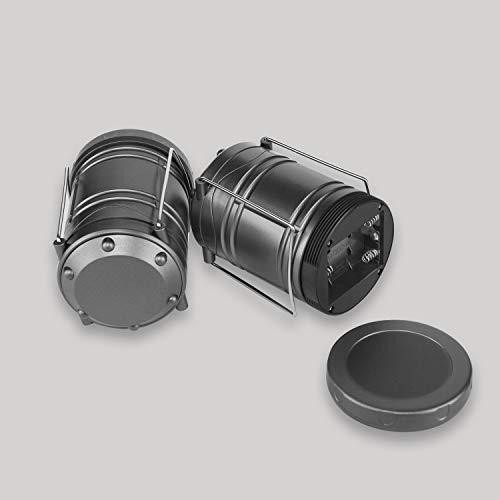
 MalloMe Camping Lights LED Lantern Flashlights2 Pack3.7 x 3.4 x 3.7 inches0.36 poundsCheck on Amazon
Best Battery Operated Camping Lights: Lumens, Runtime, and Light Quality
Read Runtime at Medium, Plan the Trip in Evenings
Convert every lantern’s specifications into the only unit a camper spends: evenings. A lantern rated for a handful of hours at maximum and several dozen at low will give you, at a comfortable medium for a table of four, a figure somewhere between, and that figure, divided by four or five hours of darkness per night, is your trip length on one charge or one set of batteries. Buy for the trip you take most, with one evening of reserve, and recharge or swap on a rhythm rather than on a failure, because a lantern that dies during dinner teaches the camp to eat in the dark with a headlamp’s dignity, which is to say none. For trips longer than the battery, the answers are a power bank sized for the lantern’s full recharge, a solar lantern that tops itself up on the picnic table by day, a vehicle charge on the drive between sites, or replaceable batteries, and a wise long-trip camper carries two of those answers, not one.
Warm Light, Red Light, and the Camp You Want to Sit In
Light quality is the difference between a camp that feels like a home and one that feels like a clinic. Warm white light, in the lower color temperatures, flatters food, faces, and tent interiors, and draws fewer insects than a harsh blue-white glare, a benefit every camper notices and no specification sheet quantifies. Red light preserves the night vision you spent twenty minutes dark-adapting, lets you find the tent zipper without waking the camp or erasing the stars, and is the correct light for the astronomer, the wildlife watcher, and the parent checking a child at 2 a.m. The better lanterns here offer both, plus dimming smooth enough to find the exact level a card game wants. Grade a lantern by sitting with it, if a shop allows, or by the modes its maker lists, and be suspicious of any lantern whose only settings are interrogation and off.
Weather, Hanging, and the Physics of a Lantern
A camping light lives outdoors, so its water resistance rating matters in the terms the IP system defines: splash resistance for a lantern that will meet rain on a table, and genuine immersion ratings for lights that may be dropped in a creek or left out in a storm. It will be hung, from a tent loop, a branch, a clothesline, so a hanging hook, a carabiner point, or a magnetic base is a working feature, not a garnish, and it will be knocked off the table by a child, a dog, or a cook, so a rubber-armored base and a recessed lens earn their keep in the second season rather than the first photograph. Finally, a lantern throws light in a circle and wastes half of it on the sky unless it is hung above the work or designed to direct it, which is why the camp that owns one good lantern and hangs it well is better lit than the camp that owns three standing on tables, shining in everyone’s eyes and illuminating nothing’s underside.
Best Battery Operated Camping Lights: Quick Comparison
| Camping Light Model | Key Specs | Best For | Typical Price Range | Rating |
|---|---|---|---|---|
| BioLite AlpenGlow 500 | Rechargeable, up to 500 lumens class, warm and color modes, red mode, power bank output, IPX5 class, hanging hook | Best overall lantern | $70 – $90 | 4.7 / 5 |
| Goal Zero Lighthouse 600 | Rechargeable, up to 600 lumens class, hand crank backup, USB power bank output, collapsible legs and hanging hook | Best for long trips and emergencies | $65 – $85 | 4.6 / 5 |
| Fenix CL26R Pro | Rechargeable, up to 650 lumens class in current versions, magnetic top and tripod mount class features, IP66 class | Best weatherproof workhorse | $65 – $85 | 4.5 / 5 |
| Coleman LED Lantern with BatteryLock, 1000 Lumens | Replaceable D-cell batteries, BatteryLock system to prevent drain, up to 1000 lumens class, rugged body | Best replaceable-battery lantern | $45 – $65 | 4.4 / 5 |
| MPOWERD Luci Base Camp (solar) | Solar and USB rechargeable, inflatable and collapsible, warm light modes, power bank output in this line class, waterproof | Best solar and packable lantern | $45 – $60 | 4.4 / 5 |
| Black Diamond Moji+ | Compact rechargeable personal lantern, up to 200 lumens class, full color and strobe modes in this line class, magnetic and hanging options, IPX5 class | Best personal tent lantern | $30 – $45 | 4.3 / 5 |

Lichamp LED Camping Lantern, 4 Pack Battery Powered Flashlight for Power Outages, Portable Collapsible Hanging Light Essential for Home, Outdoor, Emergency Lamp Survival Kit Gear for Hurricane, Gray


As an Amazon Associate we earn from qualifying purchases. Product prices and availability are accurate as of the date/time indicated.
MalloMe Camping Lights LED Lantern Flashlights, Battery Operated Lamp Tent Lanterns for Power Outages, Camping Essentials Outdoor,Home,Emergency Gear, Hurricane Survival (3 AAA batteries not included)


As an Amazon Associate we earn from qualifying purchases. Product prices and availability are accurate as of the date/time indicated.

LED Camping Tent Lantern, Portable Outdoor Waterproof Emergency Light Bulb | Battery Powered with Clip Hook, Super Bright, for Hiking, Party,Camping, Fishing, Power Failure (4 Packs, Black )
As an Amazon Associate we earn from qualifying purchases. Product prices and availability are accurate as of the date/time indicated.
Prices shown are approximate and for reference only. Prices change often, so please check the current price on Amazon before you buy.
Output and runtime figures are manufacturers’ stated maxima for current versions; sustained output and evenings of use will be lower, as this guide explains. Ratings are editorial, weighing sustained usefulness, modes, battery system, weather resistance, and value at typical prices.
The Six Best Battery Operated Camping Lights Reviewed
1. BioLite AlpenGlow 500: Best Overall Lantern
The AlpenGlow earns the head of this table by understanding camp light as an atmosphere rather than a wattage. Its warm mode makes a tent feel like a room, its color modes entertain children and mark a site, its red mode respects the night, and its battery returns a phone charge when the day’s photographs have been greedy. Output is honestly in the class a family table needs, the hanging design works, and the whole object feels designed by people who have eaten dinner under it. It is rechargeable only, so it asks for the power plan this guide teaches, and in exchange it is the lantern most camps in this guide’s readership should simply buy first.
2. Goal Zero Lighthouse 600: Best for Long Trips and Emergencies
The Lighthouse answers the rechargeable lantern’s one great question, what happens when it dies far from power, with a hand crank that turns minutes of effort into light, a feature that sounds like a gimmick in a shop and like wisdom in a storm, a blackout, or a fourth unplanned night. Around that answer it builds a complete lantern: bright, dimmable in a useful range, a power bank, collapsible legs and a hook for table or tent. Goal Zero’s ecosystem of solar panels pairs with it for the genuinely long trip. For the camper whose lights double as home emergency equipment, this is the most defensible purchase in the table.
3. Fenix CL26R Pro: Best Weatherproof Workhorse
Fenix brings a flashlight maker’s seriousness to the lantern: serious output, a weather rating that shrugs at rain that sends lesser lights indoors, mounting options, magnetic, tripod, hanging, that suit a working camp, a fishing boat, or a roadside repair as readily as a picnic table. Its light is more utilitarian than the BioLite’s warmth, which is a preference, not a fault, and its build suggests it will be reviewed again, favorably, in a decade. For the camper whose lights lead a hard life in all weathers, this is the professional’s choice in the table.
4. Coleman BatteryLock Lantern: Best Replaceable-Battery Answer
Coleman’s contribution to the category is a system as much as a lantern: BatteryLock disconnects the batteries when the lantern is stored, ending the slow drain and the corroded compartment that killed a generation of stored lanterns, so the lantern you packed in spring works in autumn. Powered by D-cells, it is bright, rugged, and revivable at any shop that sells batteries, which on a long road trip is a network no USB ecosystem matches. It is large and its light is workmanlike rather than warm. For the family that camps monthly and stores gear between, and for any reader who distrusts a sealed battery on principle, it is the correct lantern.
5. MPOWERD Luci Base Camp: Best Solar and Packable
The Luci inflates, which never stops being faintly wonderful, into a full-size lantern that packs flat to nothing, charges on the picnic table while you hike, and in its Base Camp form adds the modes and the power bank output of a serious light. Solar charging is slow and honest about it, a day of sun for a night of light at working levels, which suits the basecamp rhythm perfectly and the backpacker’s weight budget even better, since the lantern weighs almost nothing at all. For a camper whose trips run long and whose power is the sky, and for every emergency kit that should contain a light that cannot be found dead, the Luci is a small masterpiece of appropriate technology.
6. Black Diamond Moji+: Best Personal Lantern
Not every light must serve the whole camp. The Moji+ is the personal lantern perfected: small enough for a jacket pocket, bright enough to read, cook a one-person meal, and light a tent like a paper lamp, with color modes that delight children and a magnetic, hangable body that finds its place anywhere. As the second and third light in a family system, one per tent, one per child old enough to be trusted with the stars, it replaces a dozen disposable glow novelties with a tool that will last the childhood. Bought as a camp’s only light it would be undersized, and this guide says so, because its rating is for the job it is actually for.
Buying Guide: How to Build the Best Battery Operated Camping Light System
Step One: Light the Camp by Zones, Not by Lantern Count
Plan three zones and assign each a light. The table zone, cooking and eating and games, wants the strongest lantern in this table, hung above the work where it can. The tent zone wants a personal lantern per tent, warm and dimmable, with a red mode for the night. The path zone, to the water tap, the toilet block, and the car, belongs to headlamps, which this guide regards as a separate and compulsory purchase, because a lantern carried to the bathroom is a lantern absent from the table and a hazard on the path. A system of one hub lantern, one personal lantern per tent, and one headlamp per person covers a family’s whole night for less than two premium lanterns bought without a plan, and every light in it has a home, a charger, and a job.
Step Two: Choose Your Battery Philosophy and Commit
Decide, by your longest trip and your power access, between the rechargeable ecosystem, the replaceable battery discipline, or the hybrid this guide recommends for most families: rechargeable lanterns as the working lights, one replaceable-battery or solar or crank lantern as the system’s insurance, and a power bank sized to recharge the hub lantern fully at least once. Then standardize: the same charging cables in the camp box as in the car, spare batteries bought with the lantern rather than at a petrol station’s mercy, and a charging routine, in the vehicle on driving days, at home the night before departure, written on the camp box lid if that is what it takes. Battery philosophy sounds grand for a lantern. It is the difference between a system and a drawer of dead lights, and it is decided once.
Step Three: Test the Whole System on the Darkest Night at Home
Before the season, charge everything, then spend one evening in the garden or a darkened room running the camp exactly as you will run it: cook or play cards under the hub at its working setting, read in the tent under the personal lantern, walk the path with the headlamp, and time the hub’s honest output at hour three against hour one. Note the settings that served, the battery the evening consumed, and the light you wished you had, and adjust the kit by that evidence. A lighting system proven at home arrives at the site as a routine. A lighting system first assembled at the site, in the dark it was bought to cure, is a comedy the whole campground gets to watch, lit, if you are lucky, by the neighbors who read guides like this one and tested in March.
Frequently Asked Questions About Battery Operated Camping Lights
How many lumens do I actually need for camping?
For a family table, far fewer than the advertisements suggest: a lantern delivering a sustained 100 to 300 lumens at its working setting lights cooking, eating, and games comfortably for four people, and the 500 to 1000 lumen maxima in this table are best understood as headroom for large groups, big sites, and brief tasks rather than as settings to live at, because a lantern run at maximum drains its battery in a small number of hours and dazzles the camp it serves. A personal tent lantern needs only 50 to 200 lumens, with the low end of that range being where reading and sleeping children coexist. Buy for the medium setting’s output and runtime, dim everything to the evening’s actual need, and you will gain battery life, atmosphere, and the stars overhead, which are the original camping light and the only one no battery has ever improved.
Rechargeable or replaceable batteries: which is better for camping?
Rechargeable is better for the camper with a routine and a power source, which in 2026 is most of us: lower running cost, no consumables to buy and landfill, charging shared with phones and headlamps, and, in the better models, a power bank that returns the energy to the system. Replaceable batteries are better for the longest trips without power, for gear stored for months between uses, where a disconnect system like Coleman’s BatteryLock or a set of batteries stored separately keeps the lantern ready, and for the camper who wants any shop on any road to be a refueling station. The hybrid this guide recommends, rechargeable working lights with one solar, crank, or replaceable-battery lantern as insurance, captures both virtues for the price of one extra light, and is how experienced camps actually run, whatever their stated philosophy.
Can a camping lantern charge my phone?
Several in this guide can, through a USB output that treats the lantern’s battery as a small power bank, and the feature is genuinely useful for topping up a phone enough for the morning’s photographs, the drive’s navigation, or an emergency call. Understand the trade in numbers rather than in hope: a lantern’s battery is sized for light, so a full phone charge commonly costs most or all of a night’s lantern, and the exchange should be made deliberately, in daylight, with the night’s lighting already planned, rather than discovered at midnight by a dark tent. For trips where phone power is a real requirement, carry a dedicated power bank for the phones and let the lanterns light, because a system in which every device has its own energy is a system in which no device has to die for another, and camp morale, like camp light, is a resource to be budgeted before it is spent.
Why does my lantern get dimmer after an hour at full brightness?
Because it is designed to, and knowing this separates the informed camper from the disappointed one. A lantern’s maximum output generates heat in its LEDs and draws current its battery cannot sustain at full voltage indefinitely, so its electronics step the output down, gradually or in stages, to a level it can hold safely for the rest of the charge, which is why the headline lumens and the headline runtime in any listing are almost never available at the same time. This is not a defect or a deception unique to cheap models; it is physics, managed more gracefully by better lanterns. The practical responses are this guide’s whole method: judge a lantern by its medium setting, start the evening at the level the task needs rather than at maximum, and save the brightest setting for the brief moments, a dropped item, a map consultation, a late arrival’s pitch, that actually require it. Run that way, the lantern you bought is the lantern the specifications promised, for exactly as many evenings as you planned.
Related guides
- Best Premium Camp Kitchen for Dog Camping in 2026: 6 Best Premium Camp Kitchen for Dog Camping Picks for Cooking, Storage, and Reliable Camp Meals With Your Dog
- Best Solar Batteries for Camping: 6 Best Solar Batteries for Camping Picks in 2026
- Best Durable Double Hammock Heavy Use: 6 Best Durable Double Hammock Heavy Use Picks in 2026
- Best Battery for Camping Solar in 2026: 6 Solar Batteries With Built-In Solar, a Capacity of at Least 10,000mAh, and a Price Range, for Camping Solar, Without a Battery That Is Too Small, or Too Slow, for Camping Solar
More from Amazon
Programs that pair well with the guide above. Offers and eligibility are set by Amazon and may change.
Free shipping on eligible items, Prime Video and more. Eligible new members can start with a free trial.
Start a Prime free trialA Prime membership for ages 18-24 with a trial period. Eligibility is set by Amazon.
See Prime for Young AdultsAudiobooks and podcasts to listen to on the go. Eligible new members can start with a free trial.
Try Audible freeAd-free music streaming. Eligible new subscribers can start with a free trial.
Try Music Unlimited freeAs an Amazon Associate we earn from qualifying purchases.

Write Your Review
No reviews yet. Be the first to share your experience!