
What's inside
As an Amazon Associate I earn from qualifying purchases. This post may contain affiliate links at no extra cost to you.
The best battery powered backpack is not really a backpack with a gadget sewn onto it. It is a carrying system and a power system designed together, and it has to be judged on both jobs at once. As a pack, it must carry comfortably, protect gear from rain and knocks, organize the small things campers actually reach for, and survive being dropped on granite, stuffed into a trunk, and opened a hundred times with dusty hands. As a power system, it must do something much harder than the product photos suggest: turn a day of walking, much of it under trees, in cloud, or with the panel facing the wrong way, into stored electricity you can actually use at camp, in a battery you can remove, replace, and charge from a wall before you leave. That second job is where most battery powered backpacks fail their buyers. A tiny panel wired straight to a phone will charge slowly, stop in shade, and leave you with nothing stored for the night. A good design separates collection from storage: a solar panel of honest size feeds a removable power bank during the day, and the power bank, not the sky, charges your phone, headlamp, lantern, GPS, and camera at camp.
That distinction shapes every recommendation in this guide. We compare real, currently sold packs and pack-and-panel systems across three honest groups: integrated solar backpacks with a battery included, charging backpacks with a built-in USB port that pair with a power bank you choose, and modular systems where a quality folding panel attaches to a normal hiking pack you already trust. For most campers, the modular answer is quietly the best one, because backpacks and batteries age on different schedules and because a panel large enough to matter is often larger than a fashion pack can carry. But integrated packs have a real place for travel, festival camping, day hikes, and car camping where convenience beats maximum output. Throughout, the power figures are treated with the skepticism they deserve. Panel wattage is a laboratory rating under full, direct, perfectly angled sun. In the field you will collect a fraction of it, and any buying decision based on the headline wattage alone will disappoint you by the second evening.
Our Top Picks
Best Battery Powered Backpack: What the Power Numbers Really Mean
Panel Watts, Battery Watt-Hours, and a Day of Real Sun
Two numbers decide whether a battery powered backpack works, and only one of them is printed large. The first is the panel rating in watts. Small integrated packs commonly carry panels in the 5 to 10 watt class; larger solar packs and separate folding panels run from about 10 watts into the 20 and 30 watt class and beyond. The second number is the battery capacity in watt-hours, often shown instead as milliamp-hours at a phone-style voltage, where 10,000 mAh is roughly 37 watt-hours before conversion losses. A modern phone holds roughly 12 to 18 watt-hours, a headlamp or lantern far less, and a tablet or large power-hungry camera much more. The useful mental model is simple: on a bright day of hiking with regular sun on the pack, a small integrated panel may store enough for a phone top-up and a headlamp; a larger panel, carried open at breaks and angled at camp, can realistically support a phone a day for a careful user. Cloudy forest, winter sun, and a panel shaded by your own shoulders cut that sharply. Buy for the honest case, not the brochure case, and size the battery for at least one full day of your actual devices, because the battery is your buffer against weather.
Integrated, USB-Port, and Modular: Three Different Products
Integrated solar backpacks include the panel and usually a battery, and they are the simplest to buy and the easiest to use badly, because the fixed panel is often small and faces wherever the pack faces. They suit day use, travel, and campgrounds where a wall outlet resets the system every few days. USB-port backpacks are ordinary packs with an external charging port and an internal cable to a power bank pocket. They contain no power of their own, which sounds like a weakness and is often a strength: you choose a modern, replaceable power bank of the size you need, you can charge it at home in two hours, and when it ages you replace the bank, not the backpack. Modular systems, a separate folding panel strapped to any pack and feeding any power bank, give the largest panels, the best camp positioning, because the panel can be angled on a rock while the pack sits in shade, and the longest service life, at the cost of more pieces to manage. This guide includes all three, labeled clearly, because the best battery powered backpack for a thru-hiker, a festival camper, and a parent running a family basecamp are three different objects wearing the same name.
Pack First: Carry, Weather, and the Rules of the Trail
A powered pack that carries badly will be left at home, so grade the backpack before the battery. Look for padded shoulder straps and a back panel that vents, a hip belt on anything you will carry all day with water and food aboard, and a volume matched to the job, day packs in the 20 to 30 liter class, overnight packs larger, with the warning that most integrated solar packs are day packs and should not be asked to do a weekend’s work. Weather resistance matters doubly when electronics live inside: water-resistant fabrics and zippers are a minimum, and a proper rain cover or dry bags for the battery and devices are the field answer, because no charging port improves a soaked power bank. Two rules belong in every powered kit. First, lithium batteries must never be charged when they are below freezing; warm a cold power bank inside your jacket or sleeping bag before charging it, a rule that protects the cells from permanent damage. Second, know the transport rules that apply to you: airlines require spare lithium batteries and power banks in carry-on baggage, not checked bags, and capacity limits apply, so a travel use case must be checked against your carrier’s current rules before you fly.
Best Battery Powered Backpack: Quick Comparison
| Battery Powered Backpack / System | Key Specs | Best For | Typical Price Range | Rating |
|---|---|---|---|---|
| Voltaic Systems Array Solar Backpack class | Integrated solar panel in the 10W class positioning, removable battery pack in line, day pack volume | Best battery powered backpack overall | $200 – $300 | 4.6 / 5 |
| Voltaic Systems Fuse / panel + your pack class | Separate solar panel in the 10W class positioning, attaches to existing packs, removable battery in line | Best modular upgrade | $120 – $200 by configuration | 4.6 / 5 |
| ECEEN Solar Backpack class | Integrated panel in the 7W class positioning, battery pocket and USB port in line, day pack volume | Best budget integrated solar | $45 – $80 | 4.1 / 5 |
| Goal Zero Nomad panel + Venture bank class | Folding panel in the 10-20W class positioning, rugged power bank in line, works with any pack | Best rugged modular system | $180 – $300 by configuration | 4.5 / 5 |
| XD Design Bobby anti-theft backpack class | USB charging port positioning, no battery included, anti-theft day pack design in line | Best travel and commute crossover | $90 – $140 | 4.3 / 5 |
| Matein Travel Laptop Backpack class | External USB port positioning, power bank pocket, no battery included, large day pack organization | Best value USB-port pack | $30 – $50 | 4.2 / 5 |

Battery Powered Backpack Sprayer with Agitator, 120 PSI Fingertip Pressure Control, 4.0Ah Battery Operated Weed Sprayer with Telescopic Wand & 5 Nozzles for Lawn & Garden
As an Amazon Associate we earn from qualifying purchases. Product prices and availability are accurate as of the date/time indicated.

5.3Gal Battery Powered Backpack Sprayer for DeWalt 20V Battery Not Included | Built-in Mixing System, Adjustable 45–90 PSI Pressure, 39" Telescopic Wand, 6 Sprayer Nozzles for Lawn, Garden, Yard, Weed
As an Amazon Associate we earn from qualifying purchases. Product prices and availability are accurate as of the date/time indicated.
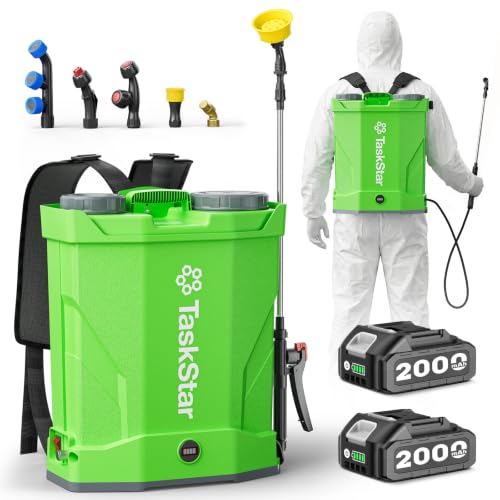
Taskstar Battery Powered Backpack Sprayer 4.2 Gallon for Lawn & Yard | 2X2000mAh Batteries, 0-100 PSI Adjustable Pressure, 32 Inch Telescopic Wand, 6 Nozzles for Garden, Farm & Tree
As an Amazon Associate we earn from qualifying purchases. Product prices and availability are accurate as of the date/time indicated.
Prices shown are approximate and for reference only. Prices change often, so please check the current price on Amazon before you buy.
Panel wattage classes refer to the makers’ published ratings under standard test conditions; field output is lower and varies with sun, angle, shade, and temperature, as described in the text. Battery inclusion is noted per row; USB-port packs require a separate power bank. Prices are typical US street ranges for the pack or the pack-and-power configuration described. Ratings are editorial for camping, weighing power-system honesty, battery replaceability, carry comfort, weather resistance, and value.
The Six Battery Powered Backpacks Reviewed
1. Voltaic Array Class: Best Overall Integrated Pack
Voltaic has built solar packs longer than almost anyone in this table, and the Array class leads because it treats power as the main job: a panel of useful size, a removable battery designed for solar input, and a pack that is still a credible day pack. It costs more than the fashion solar packs because its components are the point. For the camper who wants one integrated object that genuinely works, it is the recommendation defended first.
2. Voltaic Fuse Class and Goal Zero Nomad Class: Best Modular Systems
These two systems share a row in spirit: keep the pack you already love, add a panel large enough to matter and a battery you can replace. Goal Zero’s folding panels and rugged banks are the widely available version of the idea; Voltaic’s attachable panels are the lighter, backpack-first version. Both let you angle the panel at camp, which in practice can matter more than another five watts on paper. For multi-day trips, this is the architecture this guide trusts most.
3. ECEEN Solar Class: Best Budget Integrated
ECEEN’s solar day packs are the honest end of the budget market: a small panel, a USB port, and a battery pocket, sold at a price that matches what a small panel can actually do. Expect a phone top-up on a sunny day, not a basecamp power station, and bring your own quality power bank so the stored energy is there when you need it. Graded against its price and its real output, it earns its place; graded against a brochure fantasy, nothing in its class would.
4. XD Design Bobby Class: Best for Travel and Campground Days
The Bobby line is an anti-theft travel pack with a USB charging port, and it is included for the camper whose trips mix airports, trains, and campgrounds. It includes no battery, so pair it with a 10,000 to 20,000 mAh bank you own and can carry on the aircraft lawfully. As a hiking pack it is a day-use citizen only, and it is graded in that office, where its security features are the point.
5. Matein USB Backpack Class: Best Value Starting Point
Matein’s widely sold pack is the cheapest sensible way into the whole idea: a comfortable, organized day pack, an external USB port, and a pocket for a power bank you choose. The pack will outlast several power banks, which is exactly the right relationship between the parts. For car camping, day hikes, and keeping a family’s phones and lanterns topped up from a bank charged at home, its arithmetic is hard to beat.
Buying Guide: How to Choose a Battery Powered Backpack
Step One: Write Your Power Budget Before You Shop
List the devices you will actually charge, phone, headlamp, lantern, GPS, camera, earbuds, and estimate a day’s use in watt-hours, using the phone as roughly one full charge per active day and the small lights as fractions of that. Then choose the battery first: a bank in the 10,000 mAh class for day use and light overnight trips, the 20,000 mAh class for weekends and two people, always removable and replaceable, always chargeable from a wall so the trip can start full regardless of weather. Only then choose the panel or pack, sized to refill a realistic share of that budget on your actual trails, shaded forest arguing for a larger panel or for treating solar as a supplement, open desert and alpine travel letting a smaller panel do honest work. This order, devices, battery, panel, pack, is the whole discipline, and reversing it is how buyers end up with a handsome pack and a dead phone.
Step Two: Audit the Pack and the Connections in Your Hands
In the shop or within the return window, load the pack with your real day kit and walk stairs in it; a powered pack is usually a day pack, so it should disappear on your back at that load. Work every zipper with one hand, check that the battery pocket holds your bank without pressing its buttons, route the internal cable and confirm the external port is capped or covered against dust and rain, and confirm the battery can be removed in seconds, because a battery that cannot be removed cannot be warmed, replaced, taken into the cabin of an aircraft, or charged in the tent while the pack stays outside. If the pack has an integrated panel, take it into full sun with a nearly empty bank and confirm charging actually starts, and then walk into shade and note how it behaves; a system that stops and restarts cleanly is worth more than a larger panel that sulks. Reject any pack whose battery is sealed in permanently, since that design turns a two-year battery into the whole product’s expiry date.
Step Three: Use It as a System in the Field
Start every trip with the bank charged from the wall; solar is for extending a full battery, not for rescuing an empty plan. On the trail, clip or strap the panel where it will see the most sky, and at every long break take the thirty seconds to angle it toward the sun while you eat, because break-time positioning routinely collects more than hours of walking under trees. At camp, charge devices from the bank in the evening, keep the bank in the tent, warm it before charging in cold weather and never charge a frozen lithium battery, and keep ports capped and the bank in a dry bag when rain threatens. Log one trip honestly: what you used, what the bank held at the end, and what the panel added on your kind of trail. That log, not any listing, tells you whether your next purchase is a larger panel, a second bank, or nothing at all, and it turns the best battery powered backpack from a hopeful gadget into a measured part of your camp system, sized to your devices, your trails, and your weather.
Frequently Asked Questions About Battery Powered Backpacks
Can a solar backpack fully charge a phone every day?
Sometimes, and the honest answer depends on sun, panel size, and how much you use the phone. A small integrated panel in the 5 to 10 watt class, on a bright day with good exposure, can commonly store enough for a substantial phone top-up, and on open, sunny routes it may manage a full charge across the day. Under forest canopy, in cloud, in winter, or with the panel facing away from the sun as you walk, the same pack may store only a fraction of that. Larger separate panels in the 20 watt class and above, angled at breaks and at camp, are the reliable route to a phone a day for a careful user who keeps the phone in airplane mode and uses it as a camera and map rather than as an entertainment system. The design rule that protects you in all conditions is the battery buffer: carry a bank sized for at least a day of your devices, start full, and let solar extend it. A system bought on that rule feels dependable; a system bought on the promise of a full charge from a small panel on any trail will feel broken by the second cloudy evening.
Is a USB-port backpack the same as a battery powered backpack?
No, and the difference matters enough that this guide labels it in the table. A USB-port backpack contains no battery and no panel; it is a well-organized pack with a cable pass-through, and all of its power comes from a power bank you supply and place in its pocket. That is not a defect. It lets you choose a modern bank of the right size, charge it quickly from a wall, replace it when it ages, and use the same bank outside the pack, which is why several experienced campers prefer the arrangement. A truly integrated battery powered backpack includes its own battery, and a solar model includes a panel as well. When you compare prices, compare complete systems: the USB-port pack plus a quality 10,000 or 20,000 mAh bank is its real price, and set against an integrated pack of similar total cost, the modular version often delivers more stored energy and a longer-lived backpack. Buy the label you actually want, with the battery question answered in the listing’s fine print and not assumed from the product photos.
Can I take a battery powered backpack on an airplane?
Generally yes, with the battery treated as what it is: a lithium power bank that must travel in the cabin. Airline and regulator rules require spare lithium batteries and power banks in carry-on baggage rather than checked luggage, they set capacity limits with larger banks sometimes needing airline approval, and a battery that is built into a pack and cannot be removed can create problems at security and with those rules. Before flying, check your airline’s current published limits, confirm your bank’s watt-hour rating from its label, remove it from the pack for the flight, and carry it in the cabin with its ports protected against short circuit. For hiking after the flight, the same removability pays off in warming, replacing, and charging the bank away from the pack. If travel is a main use, that is a strong argument for the USB-port or modular designs in this guide over a sealed integrated battery, and it is a question to settle at purchase, not at the check-in desk.
How do I keep a powered backpack working in rain and cold?
Treat the electronics as campers, not as the pack’s rugged exterior. In rain, wear the pack’s rain cover or a pack liner, keep the power bank and devices in dry bags inside, keep port caps closed, and do not charge from a wet panel through a wet connector; move the bank into the tent and charge devices from stored power, which is what the buffer is for. Solar panels themselves tolerate weather within their makers’ ratings, but connections and batteries are the vulnerable points, so dry connectors before mating them and never force a swollen or damaged cable. In cold, expect every lithium battery to deliver less, keep the bank in an inside pocket or in your sleeping bag at night, and warm it before charging, because charging a lithium battery below freezing can permanently damage its cells, a rule this site repeats across every battery guide it publishes. In heat, keep the bank out of a sealed hot vehicle where you can, since sustained high temperatures age lithium cells quickly. None of this is burdensome once it is routine, and a system cared for this way will give several seasons of service, with the battery, not the backpack, replaced when its capacity finally fades.
Related guides
- Best Cooler for Beginners Large Space in 2026: Large 48-Quart to 65-Quart Coolers That Are Easy to Use
- Best Battery Operated Kettle for Camping in 2026: How to Pick a Best Battery Operated Kettle for Camping That Is Safe, Portable, and Perfect for Camp Coffee
- Eureka vs Coleman Kitchen Pros Cons in 2026: Which Camp Kitchen Is Better for Your Campsite, Your Gear, and Your Budget?
- Best Battery Pack for Camping in 2026: Anker, Jackery, Bluetti, and EcoFlow Compared for Appetites Summed in Watt-Hours With a Margin, a Swollen Battery Retired at Once, and Every Night’s Load Proven at Home Before the Trip
More from Amazon
Programs that pair well with the guide above. Offers and eligibility are set by Amazon and may change.
Free shipping on eligible items, Prime Video and more. Eligible new members can start with a free trial.
Start a Prime free trialA Prime membership for ages 18-24 with a trial period. Eligibility is set by Amazon.
See Prime for Young AdultsAudiobooks and podcasts to listen to on the go. Eligible new members can start with a free trial.
Try Audible freeAd-free music streaming. Eligible new subscribers can start with a free trial.
Try Music Unlimited freeAs an Amazon Associate we earn from qualifying purchases.

Write Your Review
No reviews yet. Be the first to share your experience!