
What's inside
As an Amazon Associate I earn from qualifying purchases. This post may contain affiliate links at no extra cost to you.
The best hammock tree straps for camping are the difference between a hammock as a system and a hammock as an accident: wide webbing that spreads the load across the bark without cutting it, a length that reaches the trees the campsite actually offers, and an adjustment system that sets the thirty-degree hang, the angle at which a hammock’s forces stay honest, in seconds and holds it through the night’s hundred small shifts. The rope or cord that came in the hammock’s box, or that the beginner improvises from the gear bin, fails on both counts at once, garroting the tree’s living tissue in a way parks increasingly prohibit, and multiplying the load through a flat hang until the cord, the hammock, or the sleeper’s dignity gives way. This guide grades six real, currently sold tree strap systems on width, length, adjustment, and rated strength, and it teaches the hang itself alongside the merchandise, the tree selection, the strap height arithmetic, and the inspection that keeps a strap system in service for a decade, because a strap is a safety device whose failure happens at the height of a sleeper’s full relaxation, above whatever the forest floor has arranged below, and it deserves to be bought and run with that sentence in mind.
Learn the forces before the table, because they explain every specification. A hammock’s suspension does not carry the sleeper’s weight; it carries the weight multiplied by the hang’s geometry, the flatter the hang, the greater the multiplication, until a nearly horizontal suspension can load each strap with several times the body’s weight, which is why the thirty-degree angle, strap descending from tree to hammock end at roughly thirty degrees from horizontal, is the discipline’s commandment: at thirty degrees the load is a manageable doubling’s neighborhood, the hammock’s lay is at its flattest and most comfortable, and the straps and trees are both inside their honest working ranges. The strap’s width is the tree’s side of the same physics, an inch to an inch and a half of webbing spreading the load across the bark’s surface so the tree’s cambium, its living growth layer just beneath, is pressed rather than cut, the standard that Leave No Trace teaches and that a growing list of parks and campgrounds now require by rule. Length is the campsite’s vote: the trees are where they are, commonly twelve to twenty feet apart for a good hang, and the strap pair must reach around both trunks and out to the hammock’s ends with adjustment to spare, which is why the longer systems in this table exist and why the short pair that served the backyard’s two posts fails the forest’s first evening.
Our Top Picks
Best Hammock Tree Straps for Camping: Width, Length, and Adjustment Systems
Webbing Width and Tree Protection: The One-Inch Floor
Buy width first: one inch is the floor this guide accepts, an inch and a half is the kinder standard the premium rows offer, and anything narrower, the cord and the rope of the improviser, is refused not for the sleeper’s sake but for the tree’s, since a cut cambium girdles and can kill the tree the next camper also needs, and the hammock community’s welcome in the parks is written, season by season, in the bark its members leave behind. The webbing’s material is polyester in the serious class, chosen for its low stretch, since a nylon strap’s elasticity turns the hang into a slow descent as the night loads it, the sleeper waking nearer the ground than they lay down, a phenomenon every nylon-strapped beginner reports once. Stitching is the webbing’s verdict: the adjustment loops, bar-tacked in the daisy-chain class in rows whose density and evenness can be read at a glance, are the strap’s strength made visible, and a strap whose stitching cannot be inspected, or whose loops are sewn with a fashion stitch, should be left on the shelf regardless of its printed rating, since the rating is a claim and the stitching is the evidence.
Adjustment Systems: Daisy Chains, Cinch Buckles, and Whoopies
The daisy chain, a strap sewn with a ladder of loops, is the category’s popular architecture: the hammock’s carabiner or hook clips the loop that sets the hang, adjustment in the increments the loop spacing offers, dead simple, nothing to slip, and the beginner’s correct first system. The cinch buckle and its continuous cousins trade the loops for infinite adjustment along a webbing’s length, the hang dialed to the exact inch, at the cost of a buckle whose correct threading is a learned motion and whose slip, in the cheap examples, is a documented disappointment, so the buckle buyer should buy the established hardware of the table’s better rows. The whoopie sling, the ultralight’s braided adjustable loop, serves the gram-counting parish with a friction hitch’s elegance and a learning curve to match, and appears in this guide’s table as the specialist’s row rather than the beginner’s, since a suspension that must be milked and dressed correctly is a skill, and skills should be bought knowingly. Whichever the system, the strap’s working length, from the tree’s wrap to the hammock’s end, must cover the campsite’s spans with the adjustment’s middle, not its last loop, doing the work, a sizing the steps will make arithmetic.
Ratings, Carabiners, and the System’s Weakest Citizen
Read the ratings as a system’s rather than a strap’s: the pair’s working load, in the several-hundred-pound class per strap for the serious rows, is quoted against the thirty-degree hang’s multiplication, and the sleeper’s true audit sums their own weight, their gear’s, and the dynamic load of the entry and the midnight turn, against the strap’s rating with the angle’s honesty assumed, since a flat hang voids the arithmetic the rating was printed in. The connection hardware is the system’s other citizen: the hammock’s own carabiners or hooks, which should be rated, smooth-gated, and free of the sharp edges that saw webbing, and the strap’s loops, which should bear on the carabiner’s basket and never on its gate. Retire by evidence, as the steps will formalize: webbing faded to a new color by the sun, stitching frayed or pulled, a cut or an abrasion through a quarter of the width, each a retirement regardless of the strap’s age or the trip’s imminence, since the replacement costs a lunch and the failure costs the fall, an exchange rate that has never once favored the gambler at two in the morning, eighteen inches above a root.
Best Hammock Tree Straps for Camping: Quick Comparison
| Hammock Tree Strap Model | Key Specs | Best For | Typical Price Range | Rating |
|---|---|---|---|---|
| ENO Atlas Suspension System | Polyester daisy chain in class, 9 ft class length positioning, 30 adjustment points in line | Best hammock tree straps for camping overall | $25 – $35 | 4.7 / 5 |
| Kammok Python 10 / 15 class | Wide webbing in class, daisy chain positioning in line, 10-15 ft lengths by model | Best length and width | $29 – $45 by length | 4.6 / 5 |
| Hennessy Hammock Tree Hugger class | Wide webbing in class, designed with hammock systems in line | Best tree protection | $15 – $30 by length | 4.5 / 5 |
| Dutchware / cottage cinch buckle suspension class | Continuous webbing with cinch buckles in class, ultralight options in line | Best fine adjustment | $30 – $55 by configuration | 4.5 / 5 |
| Bear Butt / Wise Owl strap class | Daisy chain in class, budget pricing positioning in line, long lengths by model | Best budget daisy chain | $13 – $22 by model | 4.2 / 5 |
| Grand Trunk Tree Straps class | Webbing straps in class, established brand positioning in line | Best simple alternative | $20 – $30 | 4.3 / 5 |
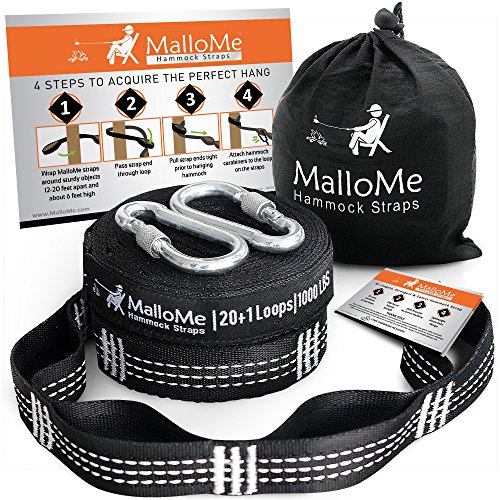
MalloMe Hammock Straps for Trees - Swing Straps - Multi-Purpose Hanging Kit, Heavy Duty Adjustable Tree Strap for Hammocks, Swings & Outdoor Use, Safe for Branch or Between 2 Trees
As an Amazon Associate we earn from qualifying purchases. Product prices and availability are accurate as of the date/time indicated.
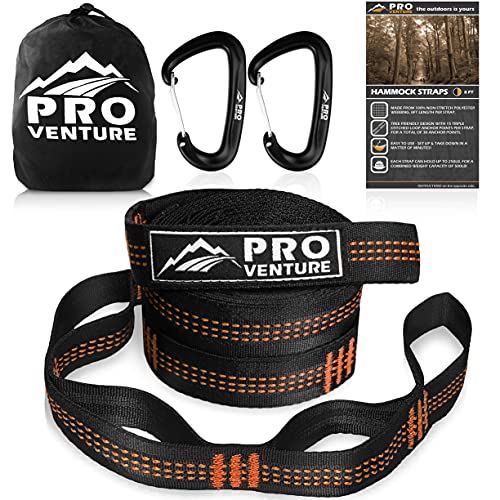
Pro Venture Hammock Straps and 2 Carabiners, 30+2 Loops, 1200lbs Breaking Strength (500lbs Rated) | 100% Non-Stretch, Lightweight, Portable Camping - Quick, Easy Setup | Heavy Duty + Tree Friendly


As an Amazon Associate we earn from qualifying purchases. Product prices and availability are accurate as of the date/time indicated.

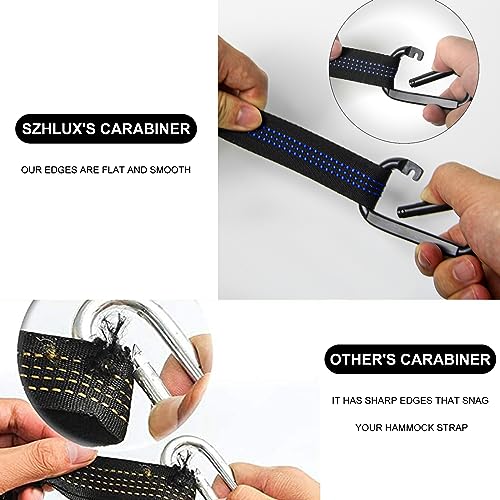
SZHLUX Hammock Straps for Trees - Set of Two 10ft Long, with 38 Loops & 2 Carabiners| Essential Hammock Accessories




As an Amazon Associate we earn from qualifying purchases. Product prices and availability are accurate as of the date/time indicated.
Prices shown are approximate and for reference only. Prices change often, so please check the current price on Amazon before you buy.
Lengths are per strap as listed by makers; confirm the pair’s total and the working load for your weight. Ratings are editorial, weighing tree protection, adjustment quality, stitching and rating honesty, length options, and value.
The Six Tree Strap Systems Reviewed
1. ENO Atlas: Best Overall
The Atlas is the category’s reference system because it executes the daisy-chain doctrine completely: polyester webbing of honest width, a ladder of well-sewn loops giving the hang its increments, a length that covers the ordinary campsite’s spans, and a rating stated for the pair’s real work. Its carabiner interface suits the fleet’s hooks and gates, its packed size is a fist’s, and its constituency is the hammock world’s majority for reasons a single season explains. For the camper buying one system to learn the hang with, it is the recommendation defended first, the strap against which the table’s bargains and premiums both define themselves.
2. Kammok Python Class: Best Length and Width
Kammok’s Pythons compete on the dimensions the campsite argues about: lengths that reach the far tree without a prayer, in the ten and fifteen foot classes, on webbing whose width is the tree’s friend, with a daisy chain’s honest adjustment and a finish above the class’s average. Their price follows their material, more webbing being more money in the plainest arithmetic in this table, and for the camper whose forests are old-growth spaced or whose backyard’s posts were placed by an optimist, they are the first row, since a strap that cannot reach is not a strap but a souvenir, and length, alone among specifications, cannot be improvised at the site.
3. Hennessy Tree Huggers: Best Tree Protection
Hennessy’s straps carry their maker’s philosophy in their name: wide webbing designed as part of a hammock system whose inventor preached tree protection before it was a regulation, sized to pair with the company’s hammocks and serviceable across the fleet. Their adjustment is the wrap-and-tie simplicity of their system rather than the daisy chain’s ladder, a method its constituency masters in one hang. For the camper whose first specification is leaving the bark as they found it, and for the Hennessy owner completing a system, they are the considered row, and their rating honors a conscience with a specification sheet.
4. Cottage Cinch Buckle Suspensions: Best Fine Adjustment
The cottage makers, Dutchware foremost in the class’s reputation, serve the dialed hang: continuous webbing through cinch buckles, the suspension’s length set to the inch and micro-corrected after the first sit stretches the system to its working truth, in weights that descend into the ultralight’s territory with the hardware’s quality intact. Their learning curve is the buckle’s threading and the webbing’s care, taught by the makers’ own videos and mastered in an afternoon, and their prices are the specialist’s. For the camper who hangs weekly and feels the daisy chain’s increments as a compromise, they are the graduation row, the suspension as an instrument rather than as an accessory.
5. Bear Butt and Wise Owl Class: Best Budget Daisy Chain
The budget daisy chains deliver the architecture’s essentials, polyester webbing, sewn loops, lengths that surprise at the price, at figures that make the pair a spare as well as a starter, and their constituency is the beginner fleet entire. Their stitching and ratings deserve the arrival inspection the steps prescribe, the class’s variance being its known biography, and their webbing’s width should be verified against the one-inch floor rather than assumed from the photograph. Auditioned honestly, they are a legitimate floor, and their rating reflects a bargain whose conditions are printed, in this guide’s manner, on its own row.
6. Grand Trunk Straps: Best Simple Alternative
Grand Trunk’s straps close the table as the established brand’s straightforward offer: webbing, loops, an honest rating, in the line of a hammock maker whose distribution puts them in the shops the camper actually visits on the trip’s eve. They concede the leaders’ refinements and the cottages’ adjustment, and they ask the class’s middle price for the class’s middle virtues, a transaction whose fairness is its recommendation. For the buyer who wants a known name, a simple system, and no research project, they are the respectable row, and their presence completes a table in which, unusually for this site, every citizen is a version of the right answer, the differences being length, adjustment, and conscience rather than kind.
Buying Guide: How to Choose and Hang Hammock Tree Straps Correctly
Step One: Measure Your Trees and Sum Your Load
Buy against your actual forests: the spans you hang, paced or estimated from your campsites’ memory, plus each tree’s circumference, which the strap must wrap with length to spare, the pair’s total working length needing to cover span, wraps, and the hammock’s own gathered ends with the adjustment in its middle register. Sum the load with the guide’s honesty: the heaviest sleeper, their gear in the hammock with them, and the understanding that the rating assumes the thirty-degree hang you are about to commit to, and choose the pair whose per-strap working rating clears the sum with the margin a safety device deserves. Choose the adjustment by your temperament, the daisy chain for the beginner and the buckle for the perfectionist, the width at an inch or beyond without negotiation, and the material polyester by name, since the nylon strap’s overnight descent is a lesson the tuition of one damp morning teaches permanently and this guide would rather you read than live.
Step Two: The Hang Itself, Tree to Tree
Select the trees as the system’s foundation: living, sturdy, a hand’s breadth and more in diameter, free of dead limbs above, the widow-makers whose inspection is a glance upward every experienced hanger performs before the straps come out, and spaced so the hammock’s span, with its sag, leaves the sleeper’s lowest point a sitting height above a ground inspected for the roots and rocks that a fall, however unlikely, would meet. Wrap the strap at the height the arithmetic gives, roughly the sleeper’s eye level for the ordinary span, higher for the longer span, since the thirty-degree angle is set by the height and the distance together; run the strap flat against the bark without twists, its full width bearing; clip the hammock’s end to the loop or set the buckle so the suspension descends at the thirty degrees the eye learns to judge, a hand’s span of rise over its run being the field approximation; and sit into the hammock gently, feet still on the ground, for the first loading, letting the system stretch to its working truth before the full weight and the night’s trust are committed, adjusting the inch the first sit always asks for.
Step Three: Inspect, Maintain, and Retire on Evidence
Keep the straps as the safety devices they are: inspected before every trip in the light, webbing read for the sun’s fading, the abrasion’s fuzz, the cut that starts at an edge, stitching read loop by loop at the bar-tacks that carry the load, and hardware, the carabiners’ gates and the buckles’ frames, worked and examined in the same pass. Wash the season’s grit out with mild soap and water, since grit in webbing is sandpaper with patience, dry them out of the sun, and store them loose and dark, the ultraviolet being webbing’s slow enemy and the garage’s window its accomplice. Retire on the evidence of the guide’s third section without appeal, and carry the retired pair’s replacement as a standing spare in the camp bin, since the strap that fails inspection at the trailhead should begin a story about a spare, not about a rope borrowed from the trunk, which is the improvisation this entire article was written to retire from the reader’s life. Run so, the hammock hangs as it should, the trees unmarked, the angle honest, the sleeper at the height of a sitting person above a kind forest floor, in the flat, diagonal lay that is the hammock’s whole promise, held there by two straps of wide webbing and the small, complete knowledge of how to use them.
Frequently Asked Questions About Hammock Tree Straps
Why can’t I just use rope or the cords that came with my hammock?
Because the rope fails the tree and then, in time, the sleeper: its narrow line concentrates the hang’s multiplied load onto a ribbon of bark, cutting into the cambium, the tree’s living layer, in a way that can girdle and kill it, which is why parks increasingly require wide straps by rule and why the hammock community polices the practice as its own survival, its welcome in those parks being the stake. For the sleeper, rope and light cord stretch, abrade, and are commonly unrated for the loads the hang’s geometry generates, the flat hang’s multiplication turning a body’s weight into several bodies’ at the anchor, against a cord whose strength is a guess. The straps in this table cost what a pizza does, are rated, sewn, and kind to the tree, and convert the suspension from the system’s improvisation into its foundation, an exchange so one-sided that the only mystery is why the cords are still in the boxes, a question the industry’s historians may answer and this guide will not wait for.
How long should my tree straps be?
Long enough that the campsite’s real spans live in the adjustment’s middle rather than at its last loop: for most eastern and campground forests, the nine-to-ten-foot class per strap serves the ordinary twelve-to-fifteen-foot spans with the wraps accounted, while the widely spaced trees of the old forests, the pines’ plantations, and the backyard’s fixed posts argue for the twelve-to-fifteen-foot class, whose spare length costs a few dollars and a few grams and is the cheapest insurance in the system. The arithmetic to run at the shelf is the guide’s: the span between trees, minus the hammock’s own length, divided between the two ends, plus each tree’s wrap, commonly two to three feet of strap around an honest trunk, and the total read against the strap’s working length rather than its overall, since the wrap’s share does no adjusting. When torn between two lengths, take the longer, since length can be doubled back and shortened at the tree, while the short strap’s deficit can only be solved by moving to worse trees, a sentence every experienced hanger has lived once and quoted forever.
What is the 30-degree rule and how do I judge it?
It is the hang’s governing geometry: the suspension strap should descend from the tree to the hammock’s end at about thirty degrees above horizontal, the angle at which the load’s multiplication stays near a doubling, the hammock’s bed lays at its flattest, and the whole system’s forces sit inside the ratings the straps were sold under. Flatter than that, the forces climb steeply toward the tearing and the tree-bending, and the hammock paradoxically lays worse, a banana of tension; steeper, the lay becomes a cocoon’s squeeze and the sleeper’s night is a hammock’s rather than a bed’s. Judge it by eye with the field’s approximation, the strap rising roughly one unit for every two it runs, or by the hand’s trick, thumb and forefinger spread as a rough protractor, and correct it by the strap’s height on the tree, higher for a wider span, since height is the variable the hanger actually controls. Then sit the first sit gently, as the steps teach, and read the result in the hammock’s lay and the lowest point’s sitting height, the two witnesses whose testimony, unlike any angle’s estimate, cannot be argued with.
How much weight can hammock straps hold?
The serious pairs in this table carry working ratings in the several-hundred-pound class per strap, figures printed against the system used as designed, the thirty-degree hang, sound trees, and the webbing in inspected condition, and the honest audit the buyer runs is their own: the sleeper’s weight plus the gear in the hammock, multiplied by the hang’s factor, near two at the correct angle and climbing steeply as the hang flattens, held against the per-strap rating with a margin, since two straps share the load as the geometry divides it. The ratings divide by class in the predictable way, the established brands’ figures being tested claims and the budget shelf’s being, occasionally, aspirations, which is why the guide’s inspection, stitching read as evidence, matters more than the number’s size. Respect the rating as a ceiling with a safety factor already inside it rather than as a challenge, retire the strap on the evidence of wear regardless of its arithmetic, and the system’s strength will remain what it was designed to be, the most boring part of the night, which is the highest praise a suspension can earn at two in the morning.
Related guides
- Best Battery Pack for Heated Camping Chair in 2026: 6 USB Power Banks With at Least 10,000mAh, USB-C, and a Price Range, for a Heated Camping Chair
- Best Premium Camp Kitchen for Fishing Trips in 2026: 7 Camp Kitchens That Offer Large Cooking Space, Strong Storage, and Reliable Performance for Fishing Trips
- Best Cooler for Poetry Retreats by Lakes in 2026: Best Cooler for Poetry Retreats by Lakes for Cold Drinks, Quiet Days, and Simple Lakeside Use
- Best Hammock for Winter Camping Warmth: 6 Best Hammock for Winter Camping Warmth Picks in 2026
More from Amazon
Programs that pair well with the guide above. Offers and eligibility are set by Amazon and may change.
Free shipping on eligible items, Prime Video and more. Eligible new members can start with a free trial.
Start a Prime free trialA Prime membership for ages 18-24 with a trial period. Eligibility is set by Amazon.
See Prime for Young AdultsAudiobooks and podcasts to listen to on the go. Eligible new members can start with a free trial.
Try Audible freeAd-free music streaming. Eligible new subscribers can start with a free trial.
Try Music Unlimited freeAs an Amazon Associate we earn from qualifying purchases.





Write Your Review
No reviews yet. Be the first to share your experience!