
What's inside
- Best Hammock Stand for Camping: Span, Height, and the Geometry the Maker Chose for You
- Quick Comparison: Best Hammock Stand for Camping Models
- Detailed Reviews: Best Hammock Stand for Camping Picks
- Buying Guide: How to Choose the Best Hammock Stand for Camping
- Frequently Asked Questions About Best Hammock Stand for Camping
As an Amazon Associate I earn from qualifying purchases. This post may contain affiliate links at no extra cost to you.
A hammock camper’s oldest enemy is a beautiful campsite with no trees, or with the wrong ones: the desert’s open sky, the beach above the tide line, the festival field, the backyard’s young saplings, the state park whose rules, sensibly, protect its trunks from a stranger’s straps. The best hammock stand for camping abolishes that enemy, and it does so at a price this guide will state as plainly as the manufacturers do not: weight, bulk, and money, in proportions that divide the market into stands a car carries, stands a strong backpacker can be argued into, and exactly one famous design, the Tensa4, that a trekker carries by intention. Choosing among them is therefore not a search for the best stand but for the stand whose compromise matches the camping: the car camper buys stability and speed, the festival and beach camper buys portability between car and pitch, and the tree-independent trekker buys the Tensa’s geometry and pays its tuition in practice setups at home. All of them share the safety doctrines this site’s hammock coverage has built, and they are repeated here because a stand concentrates them: hang the hammock so its lowest point sits at sitting height, roughly a chair’s, so a fall is a sit rather than an event; keep the suspension near the thirty-degree angle the physics prefers, which a stand’s fixed geometry mostly decides for you; never exceed the stand’s or the hammock’s stated capacity, the lower of the two governing; and test every new setup by sitting into it slowly, over ground cleared of the rocks and stumps that should never be under a hammock in the first place.
A stand also changes the hammock’s own arithmetic, and a beginner should understand the exchange before the order. Between trees, the hammock’s world is adjustable, its hang tuned by strap position and ridgeline until the lay is flat and the sag is right. On a stand, the endpoints are where the maker put them, and the hammock must fit the stand’s span and height in its stated provisions, gathered-end hammocks of the common lengths suiting most camping stands in their patterns, longer hammocks and bridge hammocks asking for specific checks against the stand’s figures rather than for optimism. The stand’s gift in return is repeatability: the same hang, every night, on any ground, in ten minutes, a consistency a travelling camper, a scout leader with six hammocks to supervise, or a backyard tester dialling in a new quilt system will value more with every trip. Its other gift is innocence: no bark harmed, no ranger’s rule strained, no 2 a.m. negotiation with a dead branch’s opinion of the load, the whole class of arboreal risk retired in favour of a frame whose engineering can be read in its maker’s stated capacity and inspected with the eyes.
The products compared here are real, currently sold hammock stands from Kammok, ENO, Tensa, YOBOgear, and Vivere, spanning the portable aluminium patterns, the trekking design, and the heavy steel yard stand included as the car camper’s honest benchmark. They are graded on setup as lived, minutes and curses on real ground at dusk; stability as felt, the sway and creak at the stand’s stated capacity with a restless sleeper aboard; packed form and weight for the transport each reader actually owns; ground manners, feet and stakes and behaviour on grass, sand, and slope in their makers’ provisions; and compatibility, the hammocks and spans each stand honestly serves in its stated figures, because a stand and a hammock are a system and should be bought as one.
Our Top Picks
Best Hammock Stand for Camping: Span, Height, and the Geometry the Maker Chose for You
The Thirty Degrees, Delivered by a Frame
A hammock’s comfort and its loads are governed by its hang angle, the suspension’s slope from horizontal, with the region around thirty degrees being the discipline’s settled preference in the pattern this site’s hammock guides teach: flatter hangs multiply the tension in every component and the squeeze on the sleeper’s shoulders, steeper hangs turn the bed into a banana and the sleeper into its filling. Between trees the angle is the camper’s to botch; on a stand it is substantially the maker’s, set by the stand’s height and span in its design, and the buyer should therefore read those two figures as the stand’s opinion about hang, checking that a hammock of their length, rigged at its usual sag, will sit with its lowest point near sitting height, high enough to clear the ground’s opinion of the night, a sleeper’s weight settling every hammock further than its empty hang suggests, and low enough that a roll out is a sit down. Stands differ here more than their photographs admit: the short, low portable patterns pitch a hammock close to the ground, suiting a nap and a festival afternoon and asking a full night’s sleeper to accept the clearance they give; the taller frames restore the tree hang’s geometry entire. Neither is wrong, and the difference is a night’s sleep, which is why this guide grades it as a headline rather than as a footnote.
Stability is the second geometry, and it is felt rather than figured. A stand holds a hammock at two points and resists, by its feet’s spread and its frame’s stiffness in its maker’s construction, the lateral life of a sleeper, the turn, the sit-up, the entry and the exit, which are the moments stands are actually tested, a hammock being a gentle load asleep and a dynamic one at its borders. The patterns in this table resist in different dialects: the wide steel yard stand by mass and footprint, the aluminium portables by triangulated legs and, in their provisions, by staking to the ground they stand on, the Tensa by a tensioned geometry that uses the sleeper’s own weight as a structural member, an elegance that rewards the owner who practised at home and punishes, with a slow and usually harmless collapse, the owner who debuts it on a beach at midnight. Ground is the third party to every design: feet that spread a load on sand and soft grass against feet that post-hole into it, stakes that hold in soil and are ornaments in sand, and a slope that asks the stand’s levelling provisions, where they exist, to be used with the humility the guide’s setup ritual prescribes.
What a Stand Does to the Rest of the System
A hammock on a stand is still a hammock system, and the beginner should plan the whole bed rather than its frame. Insulation works as it does between trees, an underquilt hanging beneath in its suspension, with the stand’s clearance audited so the quilt’s loft is not the ground’s cushion, a check the low stands make important. Rain cover changes its manners: a tarp needs its own support where no trees offer theirs, a stand’s height may or may not serve as the tarp’s ridge in the makers’ various patterns, and many stand campers pitch a separate tarp pole or accept the stand-friendly shelters in the makers’ ecosystems, a line item to budget rather than discover in the first storm. Bug nets of the hammock’s own pattern work unchanged, which on a summer’s desert night is the stand’s finest hour, a netted hammock under open sky with no tree’s permission required. And the stand’s presence in the vehicle reorganises the packing: the car camper’s stand rides as a long bag among the chairs, the trekker’s Tensa rides as poles among the tent’s, and in both cases its packed length in the maker’s figures should be measured against the boot or the pack it will actually inhabit, because a stand that does not fit the vehicle is a stand that will be left, with feeling, at home.
Durability in this category is a story of joints. A stand is assembled and struck hundreds of times, its poles telescoping or sectioning in their makers’ patterns, its hubs and locks cycling in dust and grass, and the designs that last are those whose connections are positive, buttoned, pinned, or threaded in their mechanisms, inspectable at a glance, and replaceable from the maker’s parts where offered. A buyer should work a finalist’s joints in the shop or in the returns window with the trip’s own hands, gloved if the season is gloved, and should distrust any connection that requires faith, because a stand’s failure is rarely dramatic and often merely a 3 a.m. subsidence onto cold ground, which is quite dramatic enough for the person inside the hammock.
Quick Comparison: Best Hammock Stand for Camping Models
| Model | Type, Span and Key Specs | Best For |
|---|---|---|
| Kammok Swiftlet | Portable aluminium hammock stand in Kammok’s line, stated span and capacity in maker’s figures, packed length and weight class, lounge and sleep modes in design | Best hammock stand for camping overall |
| Tensa4 | Tensioned trekking hammock stand in Tensa’s line, stated capacity in maker’s figures, pole pattern for packing, ground anchor provisions | Best for backpacking without trees |
| ENO Nomad Hammock Stand | Portable aluminium hammock stand in ENO’s line, stated span and capacity in maker’s figures, packed pattern | Best portable for ENO systems |
| YOBOgear Cricket | Portable hammock stand in YOBOgear’s line, stated weight and capacity in maker’s figures, adjustable pattern | Best ultralight portable |
| Vivere 9ft Steel Stand | Steel hammock stand in Vivere’s line, stated length and capacity in maker’s figures, heavy yard pattern | Best car and backyard value |
| ENO SoloPod | Steel hammock stand in ENO’s line, stated span and capacity in maker’s figures, heavy home and car pattern | Best heavy duty home base |

ONCLOUD 9 FT Hammock Stand Only, Heavy Duty Adjustable Indoor Outdoor Space Saving Steel Stand with Carrying Case, Universal Hammock Stand with 450 Pounds Capacity for Garden (Black)
As an Amazon Associate we earn from qualifying purchases. Product prices and availability are accurate as of the date/time indicated.
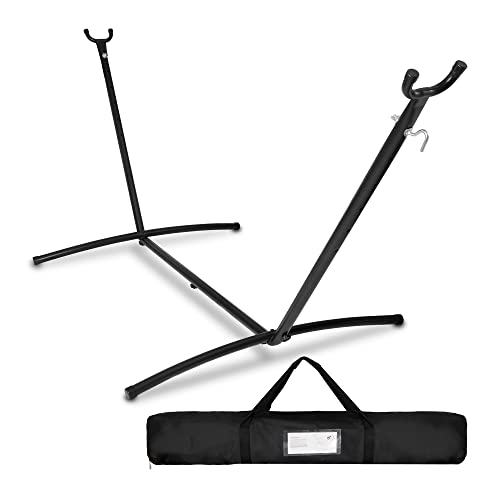
SUPER DEAL Portable 9FT Hammock Stand, Heavy Duty 2 Person 620 LBS Capacity Steel Hammock Frame with Portable Carrying Case, Adjustable 6 Optional Hook Positions, Weather Resistant Black


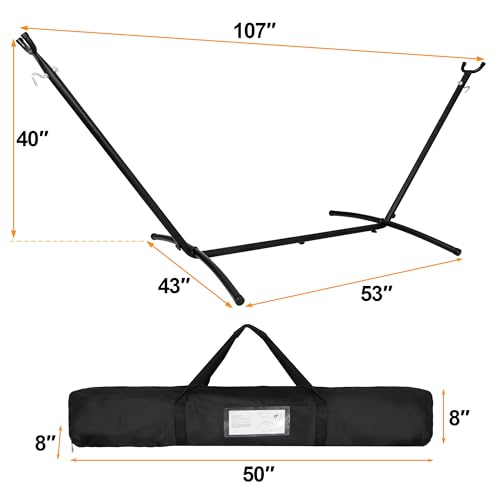

As an Amazon Associate we earn from qualifying purchases. Product prices and availability are accurate as of the date/time indicated.

Elevon Hammock Stand, Heavy Duty Adjustable Steel Hammock, 9-Foot, 450-Pound Capacity, Weather Resistant and Easy to Assemble


As an Amazon Associate we earn from qualifying purchases. Product prices and availability are accurate as of the date/time indicated.
Prices shown are approximate and for reference only. Prices change often, so please check the current price on Amazon before you buy.
Span, height, stated capacity, packed length and weight, materials, and ground provisions are each maker’s stated details for the current version, and the governing capacity for a system is the lower of the stand’s and the hammock’s. Ratings are editorial for camping: setup speed and simplicity on real ground, stability at capacity through a night’s movements, packed form for the transport the class intends, hang geometry and clearance, joint quality across seasons, and compatibility honesty.
Detailed Reviews: Best Hammock Stand for Camping Picks
1. Kammok Swiftlet – Best Overall
Kammok’s Swiftlet takes the overall rating by understanding the portable stand’s whole assignment in its line: an aluminium frame in its design that assembles in minutes without tools, adjusts between a lounge’s sit and a night’s lay in its pattern, packs into a bag a car boot accepts, and holds its stated capacity with a composure that lets a sleeper forget the trees are missing. For the camper whose sites vary, beach, field, desert, and backyard, it is the one-stand answer.
Its price is the portable tier’s. As the default, it earns it nightly.
2. Tensa4 – Best for Backpacking Without Trees
The Tensa4 is the category’s marvel in its line: a tensioned stand of poles in its design that packs into a trekker’s load, anchors to the ground in its provisions, and erects a full hang where no tree has ever offered, using the sleeper’s weight as its own structure. Its owners cross deserts and steppes with it and write about it in the tone usually reserved for good dogs.
It demands its practice, setups rehearsed at home until its geometry is a habit. Paid that tuition, it is without rival in this guide.
3. ENO Nomad – Best Portable for ENO Systems
ENO’s Nomad serves the largest hammock household in its line, a portable aluminium stand in its pattern whose span suits the maker’s hammocks and the common gathered-end class, assembling quickly for the festival, the beach, and the park’s treeless lawn. In an ENO household, with the system’s quilts and nets already owned, its coherence is a daily convenience.
Its clearance is a portable stand’s, audited as the guide directs. As the ecosystem’s stand, it is the natural purchase.
4. YOBOgear Cricket – Best Ultralight Portable
YOBOgear’s Cricket presses the portable stand toward the trekker’s weights in its line, an adjustable frame in its design for the camper who counts a car’s kilograms and a shoulder’s opinion, moto campers, cyclists, and the fly-and-drive traveller among them. It is the specialist’s answer where the Swiftlet’s substance is more stand than the transport allows.
Its price is its engineering’s. For its traveller, it is the enabling object.
5. Vivere 9ft Steel Stand – Best Car and Backyard Value
Vivere’s steel stand is the honest benchmark in its line: a heavy, simple arc of a frame in its pattern, at a price the aluminium tier cannot approach, that serves the backyard, the drive-in site, and the base camp where its weight is the car’s problem and never the camper’s. Generations of first hammocks have hung from it while their owners learned whether the life suited them.
It travels as furniture, because it is. On its own ground, it is the value of the table.
6. ENO SoloPod – Best Heavy Duty Home Base
ENO’s SoloPod closes the table as the permanent installation in its line, a steel stand of substance in its design for the garden, the deck, and the car camp that returns to the same site, where its weight becomes stability and its span takes the household’s hammocks without a negotiation. It is the stand as furniture, bought once and inherited.
Portability is not its language. As the home base, it speaks fluently.
Buying Guide: How to Choose the Best Hammock Stand for Camping
Match the Stand to the Transport, Then to the Hammock
Decide by transport first, because it is the constraint that cannot be argued with at the trailhead. The trekker and the desert walker have one honest row in this table, the Tensa4, bought with its practice tuition budgeted as part of the price. The fly-drive, moto, and weight-counting car camper shops the Cricket and the Swiftlet’s class, packed length measured against the actual boot or case. The ordinary car camper shops the whole table and should let the next test decide. That test is the hammock itself: lay out your hammock’s length and its usual rigged span, set it against the stand’s stated span and height, and compute the hang it will actually get, its lowest point at sitting height under load, its underquilt’s loft clear of the ground, because a stand and a hammock are a system bought in one decision even when they are bought in two boxes. Where the hammock is long, a bridge design, or otherwise particular, the maker’s own compatibility guidance is the authority, read before the order and not after the first sag.
Then judge the joints and the ground manners in the flesh where possible: every connection worked twice, every lock’s positivity felt, the stand erected on grass and given the entry and exit it will receive nightly, a slow sit, a turn, a sit-up, with a companion watching the feet for the lift or the sink that predicts a midnight. Check the staking and anchoring provisions against your country’s ground, sand and soil being different arguments, and price the accessories the system needs in the same basket, the tarp’s independent support where the stand cannot serve, the ground mat for the pitch’s floor, the bag that keeps the poles a system rather than a rattle.
The Setup Ritual, and the Season’s Care
Practise the stand at home until its setup is a ten-minute calm, because every stand in this table has a first-time version of its owner that the desert at dusk should not be asked to teach. On site, run the ritual this site’s hammock doctrine prescribes: ground chosen level and cleared beneath, stand erected by its maker’s pattern and checked at every joint, hammock rigged and sat into slowly, the lowest point confirmed at sitting height, the capacity of the whole system, stand and hammock, the lower figure governing and never negotiated upward by optimism. Enter and exit across the night as the stand’s design intends, without using its frame as a climbing structure, and keep children, who will regard the whole assembly as a playground’s rumour, inside the same rules with the supervision their invention deserves.
Maintain the stand as the cycled machine it is: joints rinsed of sand and grit that grind them, poles dried before packing after wet trips, locks and buttons inspected at the season’s turn, and the maker’s parts used where wear appears, because a stand’s old age should be a patina and not a surprise. Review the purchase at the season’s end against the nights it enabled, the treeless sunsets, the desert’s stars, the backyard’s testing afternoons, and let that log, rather than a catalogue, decide whether the household’s next hammock money is a second stand for a second sleeper or the quilt that extends the season. Do that, transport first, system fitted, ritual practised, and the best hammock stand for camping becomes what its makers dreamed of in their workshops: a pair of trees, folded into a bag, that go where the camper goes and ask nothing of the landscape except a little level ground and the whole of the sky.
Frequently Asked Questions About Best Hammock Stand for Camping
What is the best hammock stand for camping?
Kammok’s Swiftlet is the best overall for car and portable camping, for its minutes-fast setup, its lounge and sleep geometry, and its packed form. Tensa’s Tensa4 is the best, and effectively the only, choice for backpacking without trees, bought with practice at home as part of its price. ENO’s Nomad serves ENO households portably, YOBOgear’s Cricket is the ultralight portable, and Vivere’s steel stand and ENO’s SoloPod are the heavy, honest values for the backyard and the drive-in site. Match the stand to your transport first, then confirm the system on paper: your hammock’s rigged span against the stand’s stated span and height, its lowest point at sitting height under your weight, its underquilt clear of the ground, and the lower of the stand’s and hammock’s stated capacities governing the whole, without exception.
Can you sleep all night in a hammock on a stand?
Yes, and campers do so for whole seasons, provided the system is fitted as this guide directs. The stand’s fixed geometry must give your hammock a proper hang, its suspension near the thirty-degree region, its lowest point at about sitting height once your weight settles it, with clearance beneath for an underquilt’s loft, because insulation, not the stand, is what makes a hammock a bed rather than a nap. The low portable stands suit shorter hammocks and lighter sleepers’ clearances and should be audited honestly against a full night’s sag, while the taller frames reproduce the tree hang entire. Practise the first night at home or in the garden, where a misjudged clearance is a lesson rather than a ruined trip, test the entry and exit slowly, clear the ground beneath of anything you would not care to sit on suddenly, and keep to the lower stated capacity of stand or hammock. Slept in that discipline, a stand hammock is not a compromise bed. On a treeless shore under desert stars, it is the best bed in the county.
Will any hammock fit any camping stand?
No, and the check takes five minutes on paper that saves a season of sag. A stand offers fixed endpoints, a stated span and height, and a hammock needs its own span at its proper sag: a hammock too long for the stand hangs steep and squeezed, too short hangs flat with multiplied tension in every part, and both errors are the stand being blamed for the arithmetic. Compare your hammock’s length and its usual rigged span, ridgeline where fitted, against the stand’s stated figures and the maker’s compatibility guidance, with bridge hammocks and the longest gathered-end models treated as special cases requiring the stand maker’s explicit blessing. Confirm also the connection pattern, the stand’s hooks or loops against your suspension’s ends, and the system’s governing capacity, the lower of the two makers’ figures. Most common gathered-end hammocks of standard lengths suit most camping stands in this guide, which is why the class works at all, but suit is a verification, not an assumption, and it belongs before the order.
Is a hammock stand better than using trees?
It is better where trees are absent, protected, or wrong, and it is an unnecessary weight where good trees stand, and a camper who camps both ways will own both skills. The stand’s victories are real: the desert, the beach, the field, and the regulated park open entire; the hang is identical every night, which speeds setup and makes a scout leader’s or a tester’s life measurably calmer; no bark is harmed and no branch’s soundness is wagered on. The trees’ victories are weight, bulk, and money, a pair of straps against a bag of poles, and the infinite adjustability of a wood’s spacing against a frame’s fixed span. The honest household audit is of its own map: the sites actually camped across a season, counted, and the fraction where a stand would have been the difference between the hammock and the ground. Above a third, the stand in this guide earns its transport. Below it, the straps stay in the sack and the money goes, as this site’s hammock coverage usually concludes, into the underquilt that extends every hang’s season, on trees and on stands alike.
Related guides
- Best Battery Powered Coolers in 2026: Dometic, BougeRV, Alpicool, and ICECO Compared for a Cold Proven on a Thermometer at Dawn, Watt-Hours Summed Against the Trip’s Whole Budget, and a Compressor’s Parish Named Honestly Against the Thermoelectric’s
- Best Camping Gear for Kayaking in 2026: Sea to Summit, NRS, Watershed, and AquaQuest Compared for Gear That Rides Dry in Its Own Parish of the Hull, a PFD Worn and a Float Plan Filed, and Food Stored by Each Shore’s Own Rules
- Best Hammock for Beginners Low Budget in 2026: 7 Hammocks That Offer Easy Setup, Good Comfort, and Reliable Performance for Beginners on a Low Budget
- Campsite Mattress Buying Mistakes Avoid: 7 Campsite Mattress Buying Mistakes Avoid in 2026
More from Amazon
Programs that pair well with the guide above. Offers and eligibility are set by Amazon and may change.
Free shipping on eligible items, Prime Video and more. Eligible new members can start with a free trial.
Start a Prime free trialA Prime membership for ages 18-24 with a trial period. Eligibility is set by Amazon.
See Prime for Young AdultsAudiobooks and podcasts to listen to on the go. Eligible new members can start with a free trial.
Try Audible freeAd-free music streaming. Eligible new subscribers can start with a free trial.
Try Music Unlimited freeAs an Amazon Associate we earn from qualifying purchases.

Write Your Review
No reviews yet. Be the first to share your experience!